Computing Solar Eclipses: Calculation and Algorithms
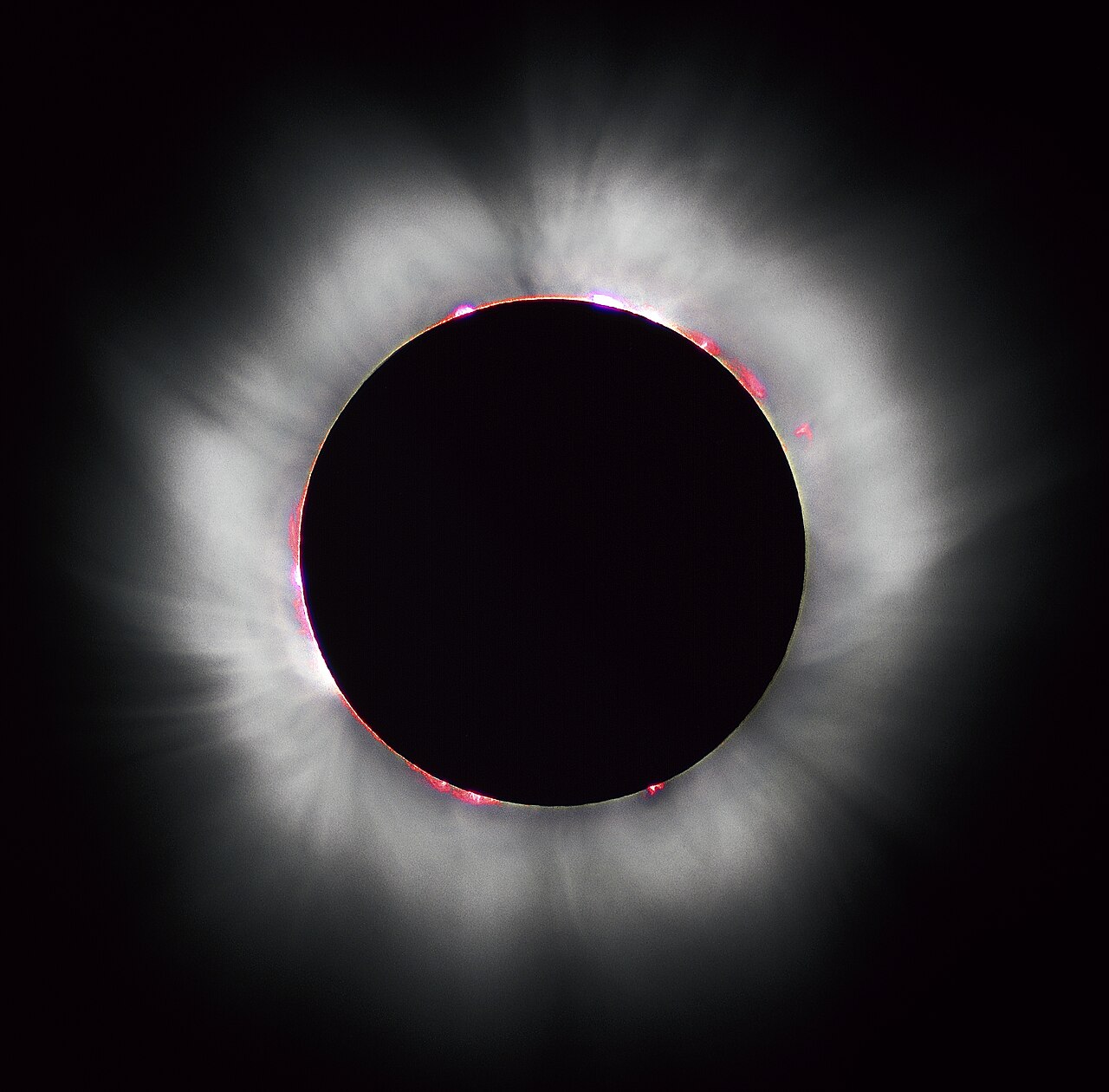
This guide covers solar eclipse calculation algorithms, their formulas, constants, datasets and validation evidence. Start with how to calculate a solar eclipse for the geometry, or follow the eclipse calculation pipeline for the implementation stages. The software comparison covers published eclipse calculators and open-source libraries.
Research and website source on GitHub.
Published predictors can disagree at a path limit because they use different models and inputs 3 2. This site sets out what a developer needs to know to compute every product, from the list of eclipses in a century to the second totality begins on one hillside, and to know how good the result is: the algorithm, the constants and where each one came from, the datasets, the published implementations, and what is still unsettled.
The source policy prioritises primary documents and published code. Equations carry their constants, and substantive claims carry graded citations. Follow the cited artefact before relying on a number. Method and source policy defines the grades and the evidence each one provides.
- Bessel's method underlies classical eclipse tables and maps. Direct topocentric calculations and raster limb tests provide alternative routes. Predictors differ in their algorithms as well as their constants and data 4 5 6.
- Solar radius, lunar limb and terrain can move a path limit by hundreds of metres to kilometres. Their effects depend on the geometry and on which corrections the predictor includes 3 7.
- Wright and Young 2024 describe NASA SVS's terrain-aware raster method. It uses an 18,000-element lunar limb from LRO and Kaguya (SELENE) topography. The paper is open access, while the surveyed public releases contain data rather than the generating code 6 8.
- The adopted solar radius remains a modelling choice. Flash-spectrum and light-curve studies infer values around 959.95 to 960.01 arcseconds. At Stephenville in 2024, predictions of 24.5 s and 12.9 s bracketed the observed 13.7 s. That comparison changes several implementation inputs, so it does not isolate the radius contribution 9 10 2.
- The surveyed open implementations do not derive limb-corrected path limits. Stellarium and NASA's JavaScript provide smooth-Moon products. The repository survey also includes a LOLA-based bead construction for a single eclipse 11 12 13.
Start here
- Executive summary: the findings that carry the most weight.
- Eclipse calculation algorithms and pipeline: nine stages with formulas, constants, outputs and validation cases.
- Error budget: every input ranked in seconds and metres.
- Reading list: the papers, code and datasets in order.
- Primer: start here if you have not computed an eclipse before.
The raw notes
Eleven topics, each a folder of notes with quoted formulas, graded citations and the questions it could not close.
| Topic | What it settles |
|---|---|
| Foundations | The eight Besselian elements, the equations from ephemeris to elements, the constants and their provenance |
| Catalogues and types | How eclipses are enumerated and classified, and which catalogues to use as fixtures |
| Global circumstances | Central line, limits, outlines, rise and set curves, durations, and the data products |
| Local circumstances | Contact times, magnitude, obscuration and position angles at one site, and the corrections |
| Lunar limb profile | Watts, Kaguya and LOLA, the DEM-to-profile geometry, and Baily's beads |
| Solar radius | Every value in circulation, what each measures, and the effect on products |
| Earth model and time | The ellipsoid, terrain and geoid, ΔT models, refraction, frames |
| Lunar and solar model | The DE ephemerides, centre of mass against figure, , libration |
| Software and repositories | Four production lineages, the open libraries, thirty repositories, the datasets |
| Validation | Observed against predicted, predictor disagreements, the error budget and protocol |
| NASA SVS and Ernie Wright | The 2024 paper, the SVS products and data, and the comparison with other predictors |
Reference
- Glossary: the jargon, defined standalone, with the formula where a term is really a quantity.
- Open questions: what this corpus could not close, each naming the artefact that would close it.
- Method and source policy: the grades, and what each one is allowed to prove.
References
- 1primary Total Solar Eclipse of 2024 Apr 08, interactive Google map (NASA GSFC eclipse web site) Read. States VSOP87/ELP2000-85, Delta T = 70.6 s, that predictions do not include lunar limb effects, that limb corrections shift limits by ~1-3 km, durations by ~1-3 s and greatest duration by ~10-20 km, and that corrected predictions are posted 12-18 months ahead.
- 2trade Besselian Elements team, Experimentally Testing Eclipse Maps Accuracy (2024) Read via WebFetch summary. Stephenville, Texas, 2024 April 8. Observed totality 13.7 s (C2 18:39:06.6, C3 18:39:20.3 UTC) versus six predictions from 12.9 s (Irwin) to 65 s (timeanddate). Authors' own experiment, so trade grade.
- 3peer-reviewed Quaglia, Irwin, Emmanouilidis & Pessi (2021), Estimation of the Eclipse Solar Radius by Flash Spectrum Video Analysis, ApJS 256:36 Full PDF read (var/downloads/quaglia2021_flash_spectrum_ApJS.txt). Flash-spectrum video from a site a few hundred metres inside the 2017 southern limit near Vale, Oregon. S = 959.95 +/- 0.05 arcsec. Gives sensitivity of duration and limit distance to solar radius, and compares Irwin's model with Occult and Solar Eclipse Maestro.
- 4peer-reviewed Explanatory Supplement to the Astronomical Ephemeris and the American Ephemeris and Nautical Almanac (1961), section 9B Eclipses and Transits Read in full (OCR text). Definitive almanac formulation: fundamental plane, point Z, x y z, mu from ephemeris sidereal time, sin f1 sin f2 with tabulated numerators for k = 0.272274, 0.2724807, 0.272281 and 0.2724880, c1 c2 l1 l2, sign convention, observer coordinates, ephemeris meridian 1.002738 ΔT, worked example 1961 Feb 15.
- 5peer-reviewed Quaglia, L., Irwin, J., Emmanouilidis, K., Pessi, A., Estimation of the Eclipse Solar Radius by Flash Spectrum Video Analysis, ApJS 256, 36 (2021), arXiv:2107.09416 Downloaded PDF and read the introduction and computational model sections. States 959.63 arcsec (Auwers 1891) is used in all published predictions, IAU 2015 nominal 959.23 arcsec, result 959.95 ± 0.05 arcsec; model uses DE430, LOLA SLDEM-256 and LDEM-128 in the ME frame, IAU 2006 Earth orientation, light time, deflection and planetary aberration, and no Besselian elements.
- 6peer-reviewed Wright, E. and Young, C. A. 2024, A Raster-oriented Method for Creating Eclipse Maps, AJ 168, 163 Original publisher PDF preserved in Wayback snapshot 2024-11-19. Sections 4-6 and Appendix A checked 2026-09-30. 0.02 degree bins imply about 600 m along the Moon, not Earth edge accuracy. Printed broken-annular criterion needs common angular normalisation. PDF SHA256 5c07500302a852e21439b0cfe8b4a94c423fd92ca3315918818009d4cbf26447. CC BY 4.0.
- 7primary Wright (2017), 2017 Eclipse Shadow Cones and Umbra Shape, NASA SVS 4517 Full HTML read from a saved copy. Terrain shifts the 2017 umbra south-east by as much as 3 km in the western states. Explains the polygonal umbra and the move from Watts to LRO and Kaguya profiles.
- 8primary NASA SVS, 2024eclipse_shapefiles.zip (78.6 MB) Downloaded from Wayback capture 2025-02-12 and parsed: umbra_hi 6741 records at 1 s 17:56:00 to 19:48:20 UTC with 12 attributes; umbra_lo 1181 at 10 s; center, duration, ppath, ppath01, upath_hi, upath_lo; all .prj GCS_WGS_1984.
- 9peer-reviewed Quaglia, L., Irwin, J., Emmanouilidis, K. and Pessi, A. (2021) Estimation of the eclipse solar radius by flash spectrum video analysis. ApJS 256, 36 Full arXiv PDF read. Accepted-paper Figure 2 and conclusions checked 2026-09-30: 959.63-to-960.00 comparison gives 1.8 s central and 19.3 s Vale duration loss; fitted 959.95 +/-0.05 arcseconds gives 1.6 s central loss. Fit depends on limb and detection model. Accepted-paper PDF SHA256 dea52d9a88577023541769f62b3ddd41c601737d64ef7afdd64ab7fe31302e95.
- 10peer-reviewed Lamy, P., Prado, J.-Y., Floyd, O., Rocher, P., Faury, G. and Koutchmy, S. (2015) A novel technique for measuring the solar radius from eclipse light curves: results for 2010, 2012, 2013, and 2015. Solar Physics 290, 2617 Seventeen photometer light curves at 540 nm with Kaguya limb profiles: 959.99 ± 0.06 arcseconds (696,246 ± 45 km). Abstract read on the Springer page; full text paywalled.
- 11company Stellarium src/core/SolarEclipseComputer.cpp Source read at pinned commit 69888f4f47af2aa4d1c9d14ec3853e874e253c73. SHA256 6ea4ddfac3c2fc921adcb75c06fd6c0062d6e7716ce566c15976c16b2020cbd5. Lines 584-587 use a small-separation angular axis approximation; global limits and observer transformations inspected. Verified 2026-09-30.
- 12primary JSEX program.js (JavaScript source of the Solar Eclipse Explorer) Source read in full (36.8 KB, downloaded 2026-09-15). GPL v2+. Contains the local-circumstance algorithm, the observer geocentric constants and the crude refraction handling.
- 13company tomasrojasc/eclipse-2026 Read live. Skyfield with DE421, LOLA LDEM_16 limb profile, moon_pa_de421 orientation, Baily's beads per bead; 84 tests; no licence stated.