Effective Coding Agents
Field-tested practices for shipping production software with AI coding agents
Effective Coding Agents
Edition: 2026-05-02 edition
Software: Anthropic Claude Code and OpenAI Codex
Synthesis: Anthropic Claude Code (Opus 4.6 + Haiku 4.5)
Review: OpenAI Codex (GPT-5.4)
Direction and Production: Sankaranarayananan Viswanathan (website, X/Twitter)
Live Version: This book may be accessed online at https://sankara.net/ai/effective-coding-agents/
Contents
- Human Contribution
- Acknowledgements
- Preface
- How This Book Was Built
- Introduction
- Part I: Foundations
- Part II: Workflow Systems
- 6. Execution Modes and Switching Signals
- 7. Specification-Driven Development
- 8. Planning and Task Decomposition
- 9. Process Frameworks for Coding Agents
- 10. Connectors, Commands, and Automation Hooks
- 11. Reviewing AI-Generated Changes
- 12. Testing and Verification
- 13. Source Control and Release Discipline
- Part III: Advanced Workflows and Runtime Tradeoffs
- Part IV: Teams, Governance, and Human Costs
- Conclusion
- Sources
Human Contribution
This book was produced with AI-assisted tools under human direction. Human contribution included defining the thesis, audience, and scope of the book; setting the source selection criteria; curating and maintaining the underlying corpus; approving and revising the chapter structure; directing chapter rewrites and editorial changes; and deciding what was included in this published revision.
The protectable human contribution, to the extent recognized by applicable law, is centered in the selection, arrangement, editorial revision, and production of the work as a whole. AI systems assisted with synthesis, drafting, review, and formatting, but final publication judgment remained human.
Acknowledgements
This edition draws on work from 160 distinct cited authors and organizations. We thank all of them for publishing detailed field reports, tutorials, hard-won lessons, and working notes that made this synthesis possible. The full provenance for every cited claim appears in the Sources section.
Preface
AI coding agents are already useful enough to change day-to-day software work, but only if you treat them as engineering tools rather than magic. This book is a field manual for that reality. It is written for practitioners who already know how to build software and now need a reliable way to use agents without losing quality, judgment, or control.
You will not find installation walkthroughs, model theory, or product marketing here. You will find working practices: how to choose the right interface, shape context, encode standards in rules and skills, review generated changes hard enough to trust them, and decide when autonomy helps versus when it just creates cleanup work.
The tools in this space will change quickly. The operating problems are more durable. Every serious coding-agent workflow still runs into the same constraints: incomplete context, shallow confidence, noisy diffs, brittle automation, review bottlenecks, cost pressure, and team governance. This book stays focused on those constraints because they determine whether agent use becomes real leverage or expensive theater.
Use the chapters selectively if that suits your work. If you are early, start with the foundations and the core execution loop. If you already use agents daily, jump to the chapters on review, testing, permissions, cost, and team rollout. The goal is simple: help you ship production-quality software with more leverage and fewer self-inflicted mistakes.
Chapter Overview
Chapter 1: The Agent Landscape and Tool Choice — How to choose between CLI, IDE, cloud, and open-source agents; what capabilities matter most; and how interface, latency, privacy, and workflow shape the right fit.
Chapter 2: How Coding Agent Harnesses Work — The harness is the real operational system around the model: tool dispatch, permission boundaries, state persistence, recovery paths, extensibility, and the control surfaces that make one coding agent feel very different from another.
Chapter 3: Persistent Instructions and Rules — How to encode project standards and defaults in instruction files and scoped rules without turning them into bloated prompt dumps.
Chapter 4: Skills, Prompts, and Agent Specialization — How reusable prompts, skill systems, and role-specialized agent setups turn recurring work into deliberate operating leverage instead of ad hoc prompting.
Chapter 5: Context Engineering and Session Control — The core discipline of deciding what the agent sees, what it does not see, and how context is staged, compressed, branched, and bounded during normal operation before degradation turns into workflow failure.
Chapter 6: Execution Modes and Switching Signals — How to choose between manual coding, assisted editing, and full agent execution, and what signals tell you to switch modes before quality or comprehension collapses.
Chapter 7: Specification-Driven Development — Using structured requirements and explicit acceptance criteria to make agent work predictable, reviewable, and easier to verify.
Chapter 8: Planning and Task Decomposition — How to break work into bounded tasks and planning steps so agents can execute reliably without losing the thread.
Chapter 9: Process Frameworks for Coding Agents — A comparative look at higher-level workflow overlays such as OpenSpec, Spec Kit, BMAD, and Superpowers: what capabilities they package, what problems they standardize, and when the added ceremony is worth it.
Chapter 10: Connectors, Commands, and Automation Hooks — How to extend agents with MCP servers, slash commands, custom tools, and hooks so they can operate inside real development environments without turning the workflow into framework-building.
Chapter 11: Reviewing AI-Generated Changes — How to keep review credible when agents can produce large diffs quickly: what humans must still inspect, what can be automated, and how to balance throughput against real comprehension.
Chapter 12: Testing and Verification — How to verify AI-generated changes end to end: test design, regression detection, executable evidence, CI gates, and the tradeoff between speed and real confidence.
Chapter 13: Source Control and Release Discipline — How to keep AI-assisted changes reviewable and releasable through scoped diffs, commit hygiene, pull request structure, CI interaction, and deployment safeguards, focusing on packaging and release mechanics rather than agent-assisted deployment work or verification strategy.
Chapter 14: Agents Across the SDLC — How to use agents beyond raw implementation work: requirements clarification, repository archaeology, design exploration, software debugging investigations, deployment and operations support, and other delivery tasks where agents help most but do not replace engineering judgment.
Chapter 15: Coordinating Multiple Agents — How to split work across multiple agents, assign specialized roles, and manage handoffs and shared context without drifting into unnecessary framework construction.
Chapter 16: Bounded Autonomy and Permission Design — How to choose approval modes, escalation paths, stop conditions, tool scopes, and pause points for unattended agent work, and how to design checkpoints that make autonomy reversible without turning failure diagnosis itself into a separate recovery playbook.
Chapter 17: Diagnosing Agent Workflow Failures — How agent-assisted workflows fail in practice, how to distinguish context, model, environment, and process failures from ordinary software debugging work, and what signals to inspect before restarting, escalating, or changing strategy.
Chapter 18: Models, Caching, and Cost Control — What model choice, prompt caching, KV caching, token reuse, context length, and pricing mechanics do to the real cost and latency of coding-agent workflows, and what practitioners can actually optimize.
Chapter 19: BYOK, Local Models, and Self-Hosted Agents — How to work with your own model providers, OpenAI-compatible endpoints, local model runtimes, and self-hosted agent setups, including when the control is worth the capability or operational tradeoff.
Chapter 20: The Psychology of AI-Assisted Work — The human cost of sustained agent use: anxiety, compulsion loops, loss of flow, identity shift, over-reliance, and the habits required to keep the work sustainable.
Chapter 21: Teams, Governance, and Enterprise Constraints — How teams adopt coding agents under real constraints: code ownership, trust boundaries, compliance, auditability, rollout discipline, and the organizational implications of sustained agent use.
Chapter 22: Measuring Productivity and Impact — What agents actually change about throughput, quality, cost, and comprehension, and why simplistic productivity narratives fail under real engineering conditions.
How This Book Was Built
This edition was not written as a single uninterrupted manuscript. It was built through a run-scoped synthesis pipeline over a shared corpus of practitioner articles, with human direction at every major checkpoint.
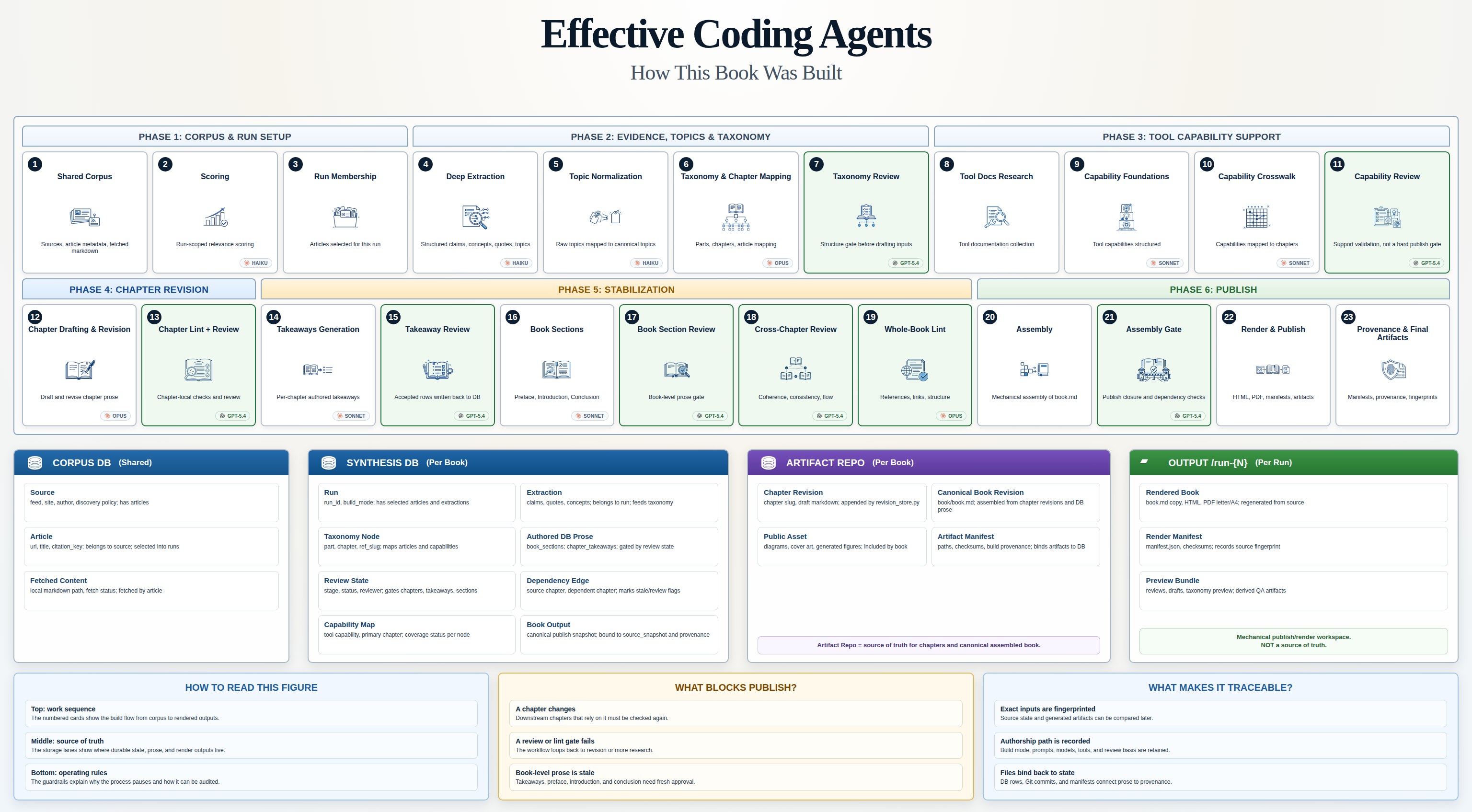
Articles were scored, selected, deeply extracted, normalized into recurring topics, clustered into a book taxonomy, drafted into chapters, reviewed through lint and independent gates, and then assembled into the published Markdown, HTML, and PDF outputs. Human direction remained responsible for the brief, chapter boundaries, revision choices, and the final publication decision.