← Home
Astrophotography
Deep-sky and solar-system images from a brief but intense phase
My astrophotography interest grew out of the Venus transit of June 2012, shot with just a DSLR on a photo tripod. Over the following year the kit evolved into a Sky-Watcher NEQ6 mount with a refractor imager, and I was actively shooting through 2015 — mostly during dark-sky weekends at coffee estates in Coorg or at the YMCA camp in Yelagiri.
The deep-sky frames were captured with the NEQ6 carrying either an Explore Scientific ED80 refractor or a Canon EF 70-200 mm lens, guided with PHD2 and recorded through BackyardEOS. Solar-system events — transits, planetary conjunctions, comet appearances — are mostly single-frame or short-burst captures on a fixed tripod, with whichever Canon lens fit the field. Nearly everything in this collection was recorded on an unmodified Canon EOS 60D.
The original reductions were built from stacked long-exposure subframes in DeepSkyStacker and finished in Photoshop. I am now revisiting selected deep-sky data in PixInsight with a nearly fully automated pipeline: Codex helps script the runs, compare variants, preserve the decision trail, and publish the processing notes. Where a newer PixInsight version exists, the gallery leads with that result; the notes, scripts, and project logs are public in my kvsankar/pixinsight repository, with a separate PixInsight project gallery on GitHub Pages.
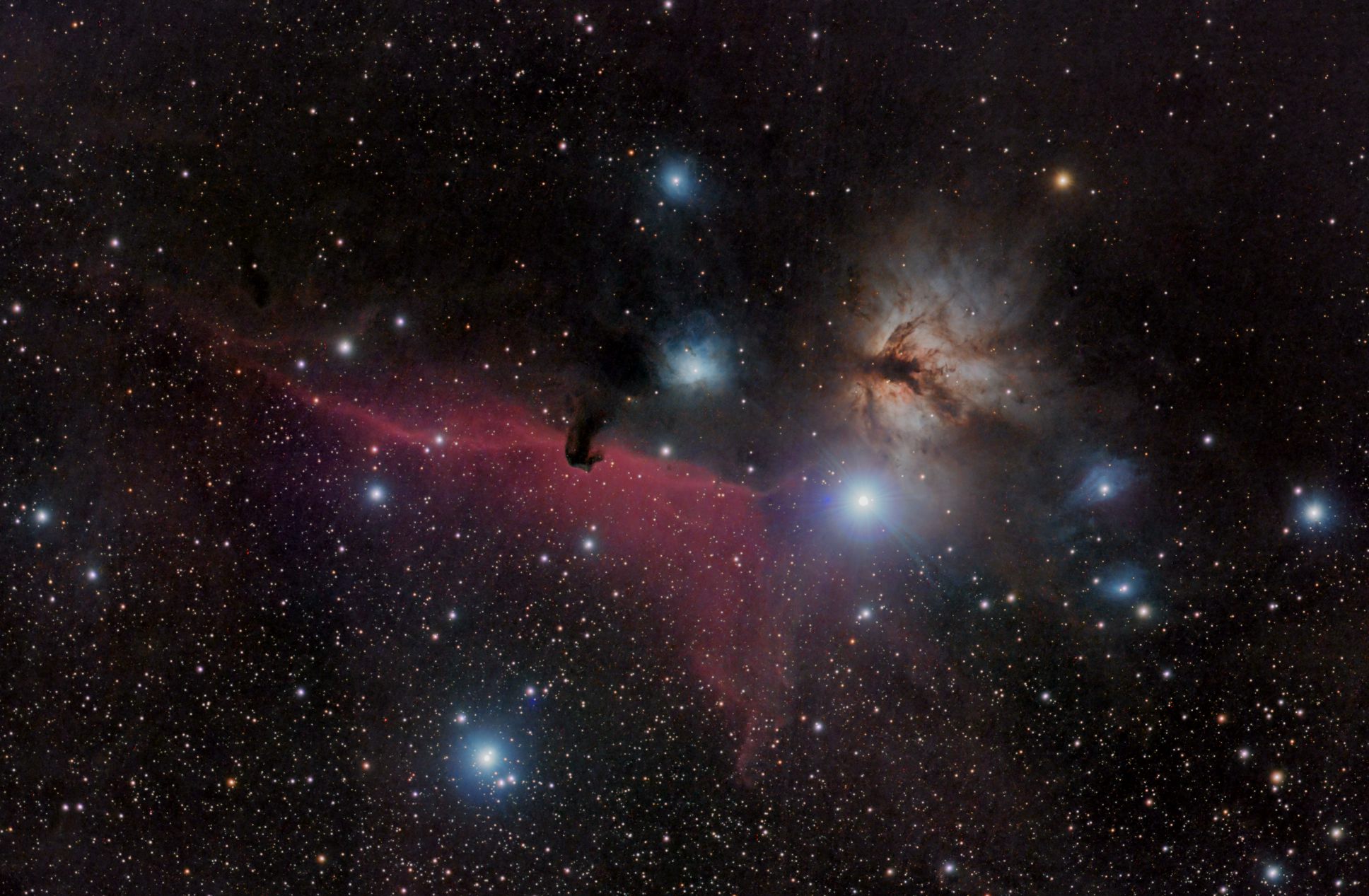
Horsehead and Flame Nebulae — B33 / NGC 2024
The Horsehead Nebula (Barnard 33) is a dark dust silhouette against the bright emission nebulosity of IC 434, in Orion's belt region. The orange-tinted glow at upper-left is the Flame Nebula (NGC 2024), set off by the bright supergiant Alnitak (ζ Orionis).
PixInsight BXT/NXT reprocess, 2026
Technical details
- Imaging date & location
- 2013/12 · Keemale Estate, Coorg, Karnataka, India; 2016/01 · Yelagiri, Tamil Nadu, India for modified-camera red support
- Processing date
- 2026/05
- Light frames
- 23 × 240 s at ISO 1600 (~92 min total integration)
- Calibration
- 9 darks; no flats, no bias
- Mount
- Sky-Watcher NEQ6 Pro
- Imaging telescope
- Explore Scientific ED80 air-spaced doublet refractor
- Imager
- Canon EOS 60D DSLR (unmodified)
- Guide telescope
- Orion Short Tube 80
- Guide camera
- Orion StarShoot AutoGuider (SSAG)
- Capture software
-
PHD2 for guiding,
BackyardEOS for capture,
and EQMOD for mount control.
- Processing
-
PixInsight WBPP/linear processing with BXT/NXT on the 2013 Canon 60D broadband stack plus 2016 modified T1i red/H-alpha support,
registered and blended as the accepted
04c v1 presentation candidate.
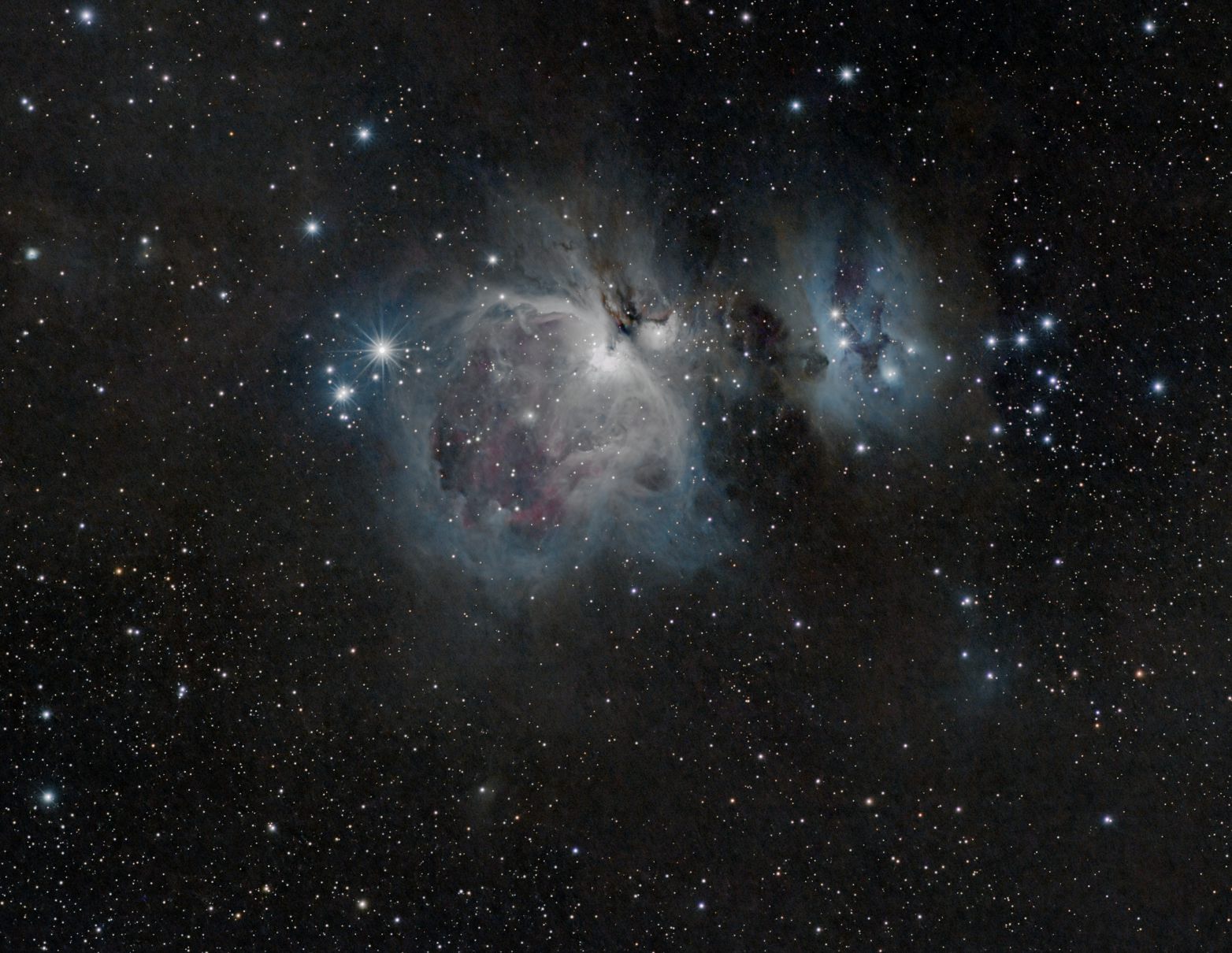
Orion and Running Man Nebulae — M42 / NGC 1977
The Orion Nebula (M42 / NGC 1976), the closest stellar nursery to Earth, with the smaller Running Man Nebula (NGC 1977) above it. Shot wide-field with a camera lens rather than a telescope, then cropped tight on the bright nebulosity.
PixInsight BXT/NXT reprocess, 2026
Technical details
- Imaging date & location
- 2013/02 · Keemale Estate, Coorg, Karnataka, India
- Processing date
- 2026/05
- Light frames
- 31 × 180 s + 20 × 300 s at ISO 1600 (~3 h 13 min total integration)
- Calibration
- 9 × 180 s darks at 33 °C; 6 flats; no bias
- Mount
- Sky-Watcher NEQ6 Pro GoTo
- Imaging optic
- Canon EF 70-200 mm f/2.8L IS II USM lens at 200 mm, stopped to f/3.5 (no telescope)
- Camera
- Canon EOS 60D DSLR (unmodified)
- Guide telescope
- Orion Short Tube 80 (piggybacked on the mount)
- Guide camera
- Orion StarShoot AutoGuider (SSAG)
- Capture software
- BackyardEOS for capture.
- Processing
-
PixInsight WBPP/ABE/plate solving/SPCC, BXT/NXT, MaskedStretch, core compression, and a quieter no-300s presentation to control background texture.
- Field of view
- ~7.7° wide native; final image cropped to about 2°.
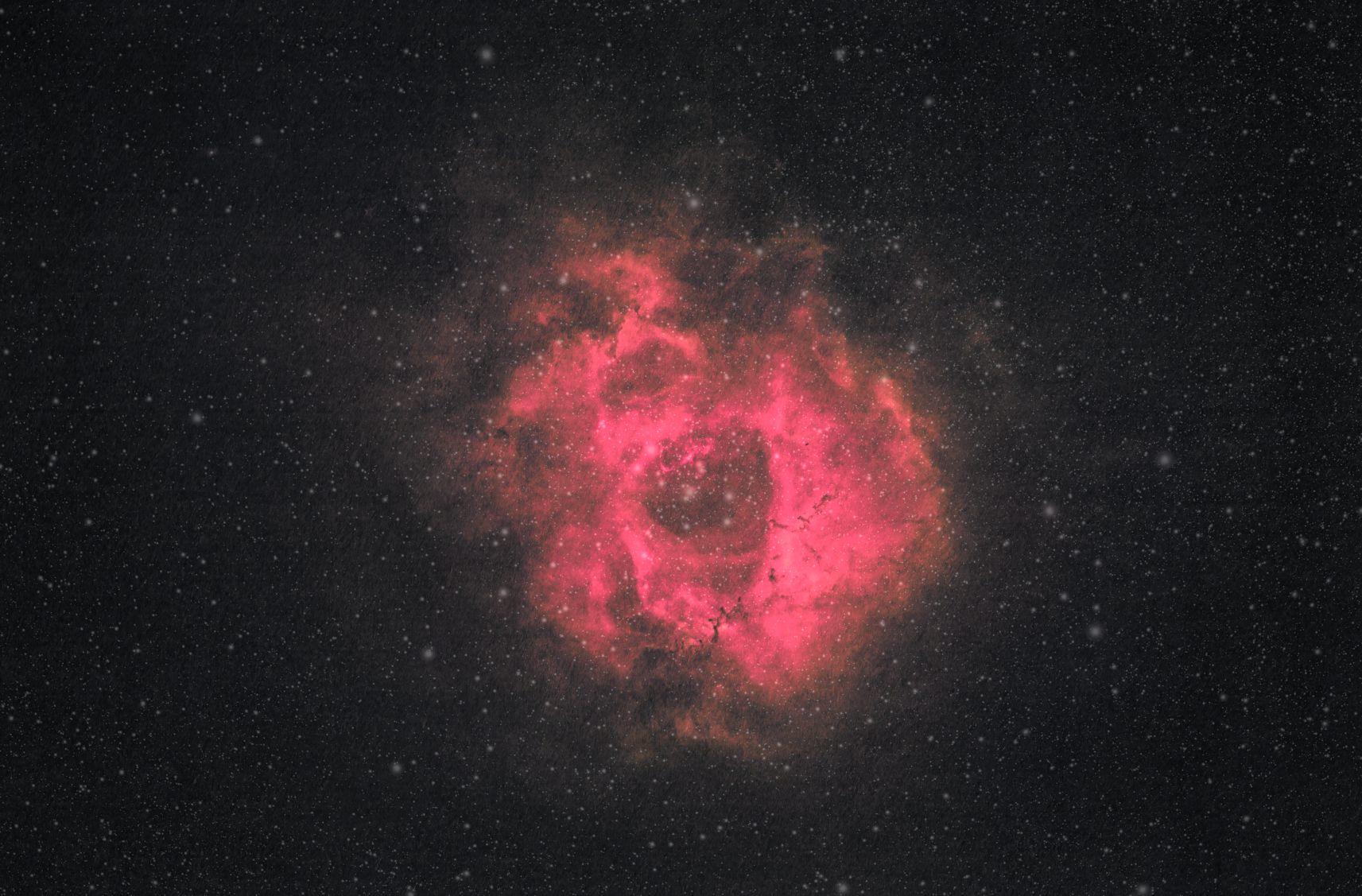
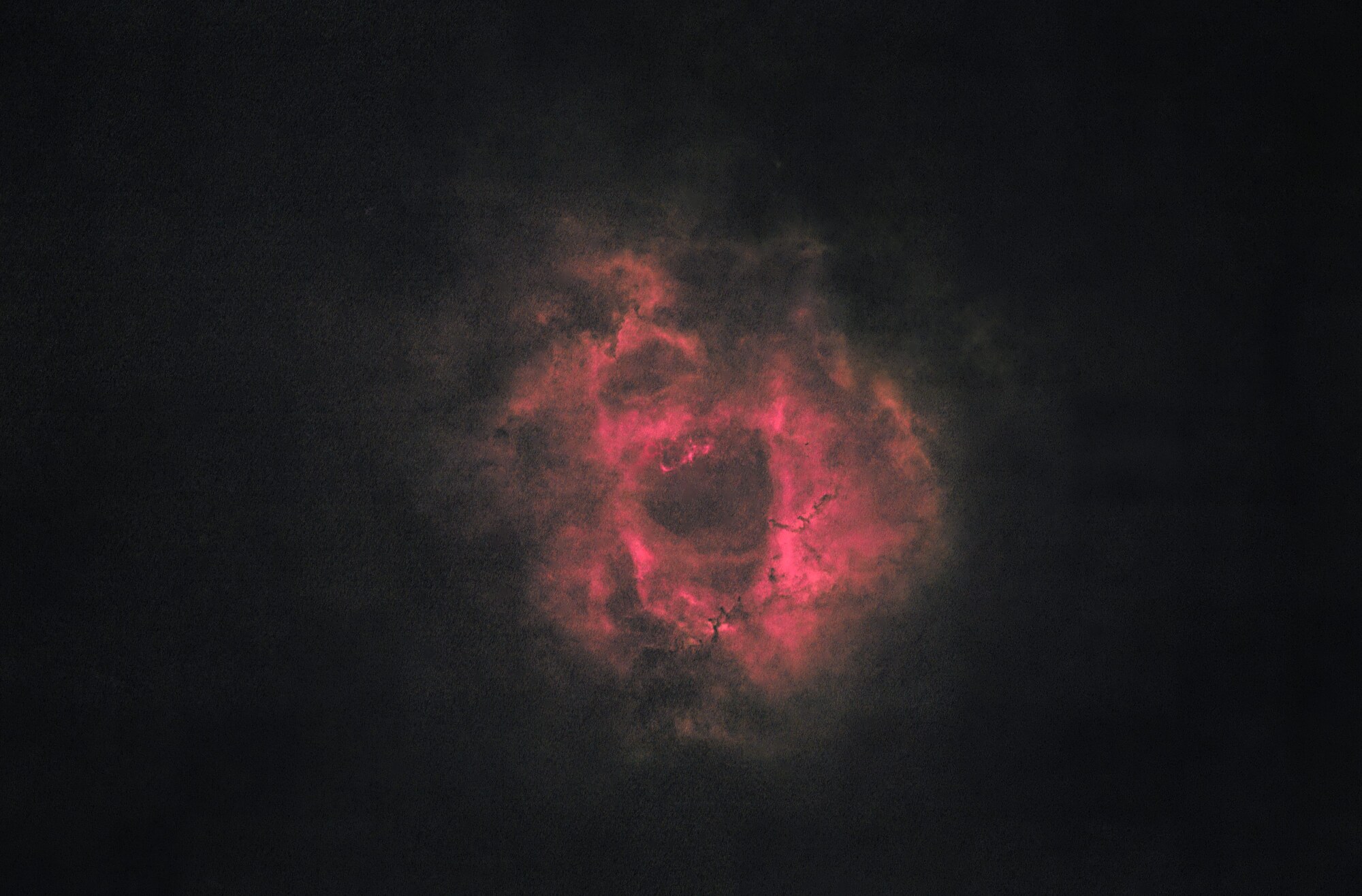
Rosette Nebula — NGC 2237
A vast emission nebula in Monoceros, ~5,000 light-years away, with the young open cluster NGC 2244 at its centre — the cluster's hot stars ionize the surrounding hydrogen gas, sculpting the rosette shape.
PixInsight BXT/NXT + StarXTerminator, 2026 · Starless 2026 variant
Technical details
- Imaging date & location
- 2014/03 · Keemale Estate, Coorg, Karnataka, India
- Processing date
- 2026/05
- Light frames
- 31 × 240 s at ISO 1600 (~2 h 4 min total integration)
- Calibration
- 9 darks (240 s, ISO 1600); no flats, no bias
- Mount
- Sky-Watcher NEQ6 Pro
- Imaging telescope
- Explore Scientific ED80 air-spaced doublet refractor
- Imager
- Canon EOS 60D DSLR (unmodified)
- Guide telescope
- Orion Short Tube 80
- Guide camera
- Orion StarShoot AutoGuider (SSAG)
- Capture software
-
PHD2 for guiding,
BackyardEOS for capture,
and EQMOD for mount control.
- Processing
-
PixInsight WBPP/DBE/SPCC visual branch, BXT/NXT, StarXTerminator separation, and sparse real-star recombination over the red/depth nebula treatment.
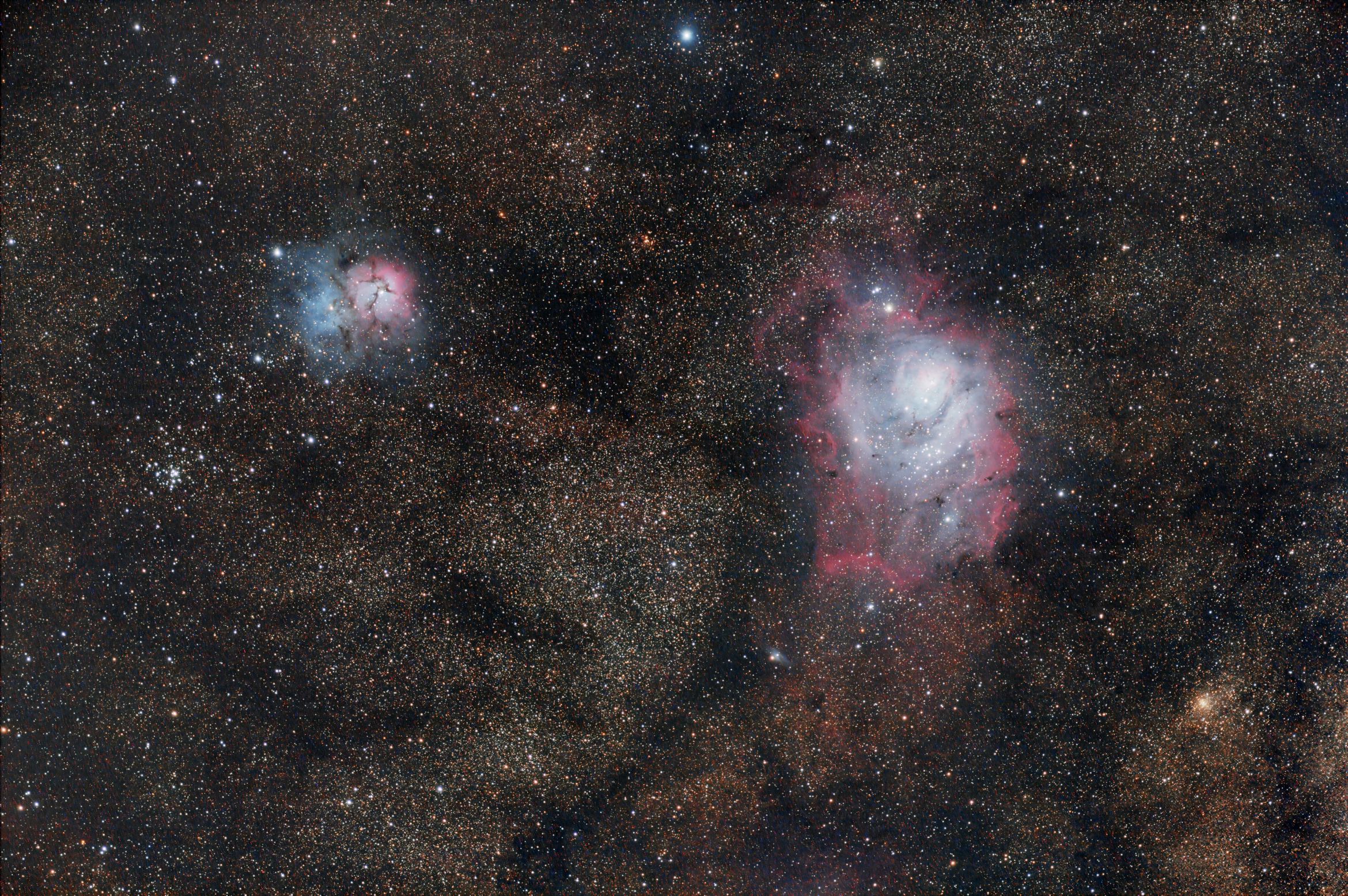
Trifid and Lagoon Nebulae — M20 / M8
A wide-field of two of the brightest emission nebulae in Sagittarius — the Lagoon (M8, NGC 6523) at lower right and the smaller, three-lobed Trifid (M20, NGC 6514) at upper left. Both are in our galaxy's Sagittarius arm, ~4–5 thousand light-years away.
PixInsight BXT/NXT March polish, 2026
Technical details
- Imaging date & location
- 2014/03 · Keemale Estate, Coorg, Karnataka, India
- Processing date
- 2026/05
- Light frames
- 38 × 120 s at ISO 1600 (~1 h 16 min total integration)
- Calibration
- 5 darks (120 s, ISO 1600); no flats, no bias
- Mount
- Sky-Watcher NEQ6 Pro
- Imaging telescope
- Explore Scientific ED80 air-spaced doublet refractor
- Imager
- Canon EOS 60D DSLR (unmodified)
- Guide telescope
- Orion Short Tube 80
- Guide camera
- Orion StarShoot AutoGuider (SSAG)
- Capture software
-
PHD2 for guiding,
BackyardEOS for capture,
and EQMOD for mount control.
- Processing
-
PixInsight March 2014 branch using 38 × 120 s lights as a separate no-dark/no-flats integration,
followed by subtractive ABE, plate solving, SPCC, conservative BXT/NXT, MaskedStretch, and final color/contrast polish.
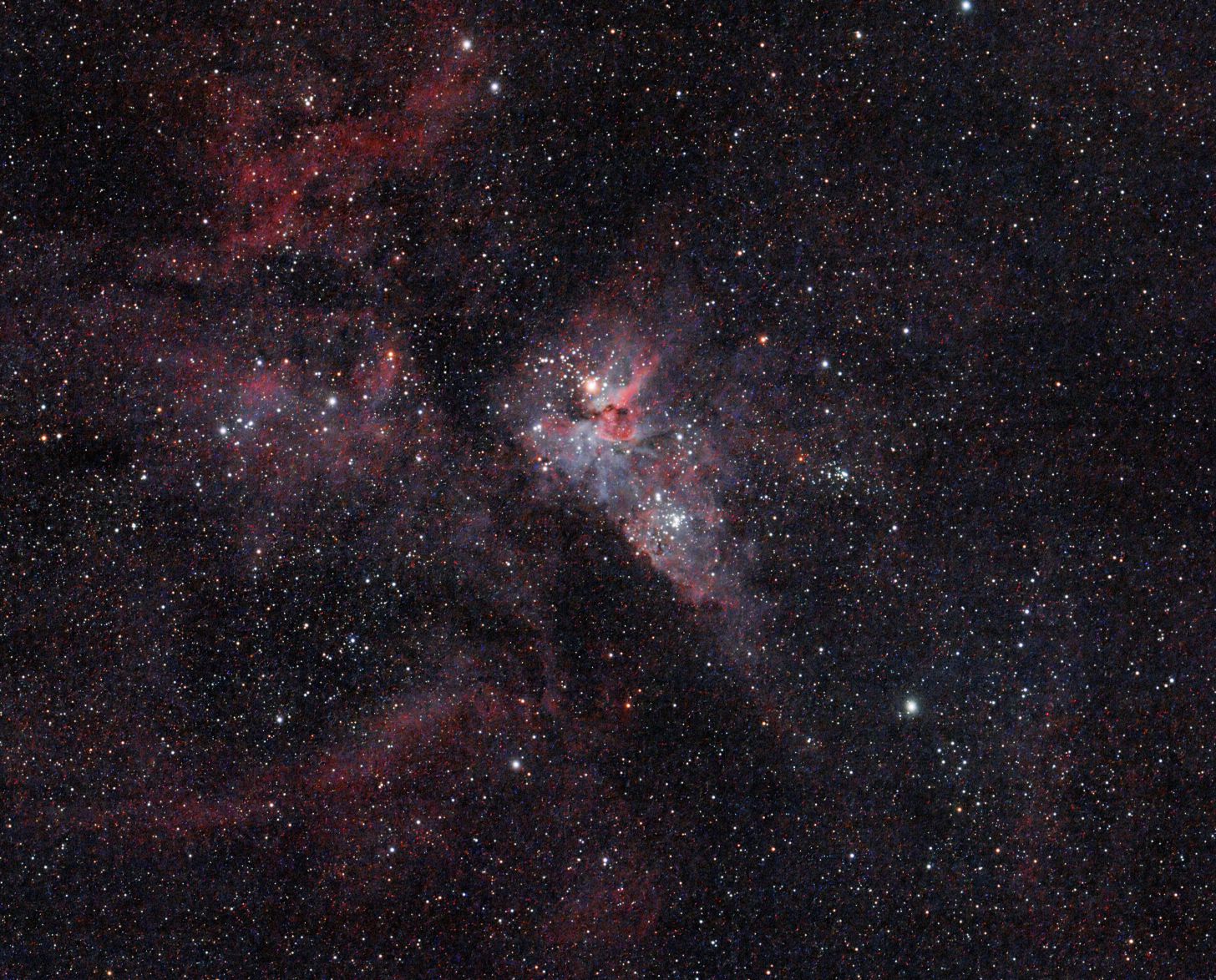
Eta Carinae Nebula — NGC 3372
The Carina Nebula is one of the southern sky's great emission-nebula complexes, built around the unstable massive star Eta Carinae and the dark Keyhole region. This crop focuses on the bright central nebula and surrounding red emission from a low-altitude Yelagiri capture.
PixInsight BXT/NXT v4 clean extra stretch, 2026
Technical details
- Imaging date & location
- 2013/03 · Yelagiri YMCA camp, Tamil Nadu, India
- Processing date
- 2026/06
- Light frames
- 16 × 120 s at ISO 1600 (~32 min total integration)
- Calibration
- No darks, flats, or bias in the accepted 120 s branch
- Mount
- Sky-Watcher NEQ6 Pro
- Imaging telescope
- Explore Scientific ED80 air-spaced doublet refractor
- Imager
- Canon EOS 60D DSLR (unmodified)
- Guide telescope
- Orion Short Tube 80
- Guide camera
- Orion StarShoot AutoGuider (SSAG)
- Capture software
-
PHD2 for guiding,
BackyardEOS for capture,
and EQMOD for mount control.
- Processing
-
PixInsight WBPP 120 s no-dark/no-flats baseline, ABE, plate solving, SPCC, SCNR, conservative BXT/NXT, MaskedStretch, Carina-centered crop, extra stretch, and protected low-sky chroma cleanup.
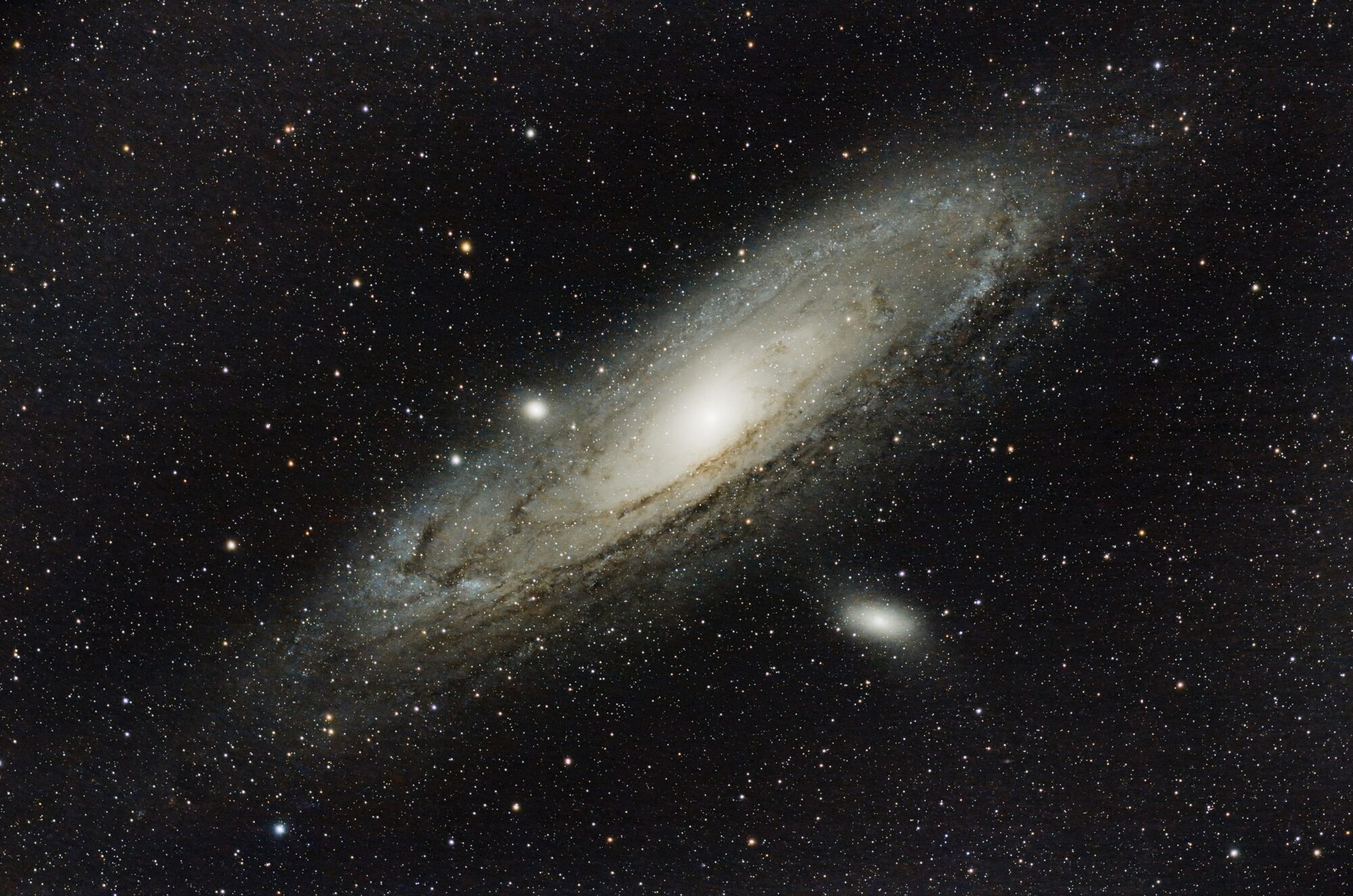
Andromeda Galaxy — M31
The Andromeda Galaxy (M31), our nearest large spiral neighbour at about 2.5 million light-years. Its small companion ellipticals M32 and M110 are visible alongside the central bulge.
PixInsight BXT/NXT reprocess, 2026
Technical details
- Imaging date & location
- 2013/12 · Keemale Estate, Coorg, Karnataka, India
- Processing date
- 2026/05
- Light frames
- 28 × 240 s at ISO 1600 (~112 min total integration)
- Calibration
- 9 darks; no flats, no bias
- Mount
- Sky-Watcher NEQ6 Pro
- Imaging telescope
- Explore Scientific ED80 air-spaced doublet refractor
- Imager
- Canon EOS 60D DSLR (unmodified)
- Guide telescope
- Orion Short Tube 80
- Guide camera
- Orion StarShoot AutoGuider (SSAG)
- Capture software
-
PHD2 for guiding,
BackyardEOS for capture,
and EQMOD for mount control.
- Processing
-
PixInsight WBPP with matched darks, ABE, plate solving, SPCC, BXT/NXT, MaskedStretch, HDR/LHE detail work, crop, and mild star/detail polish.
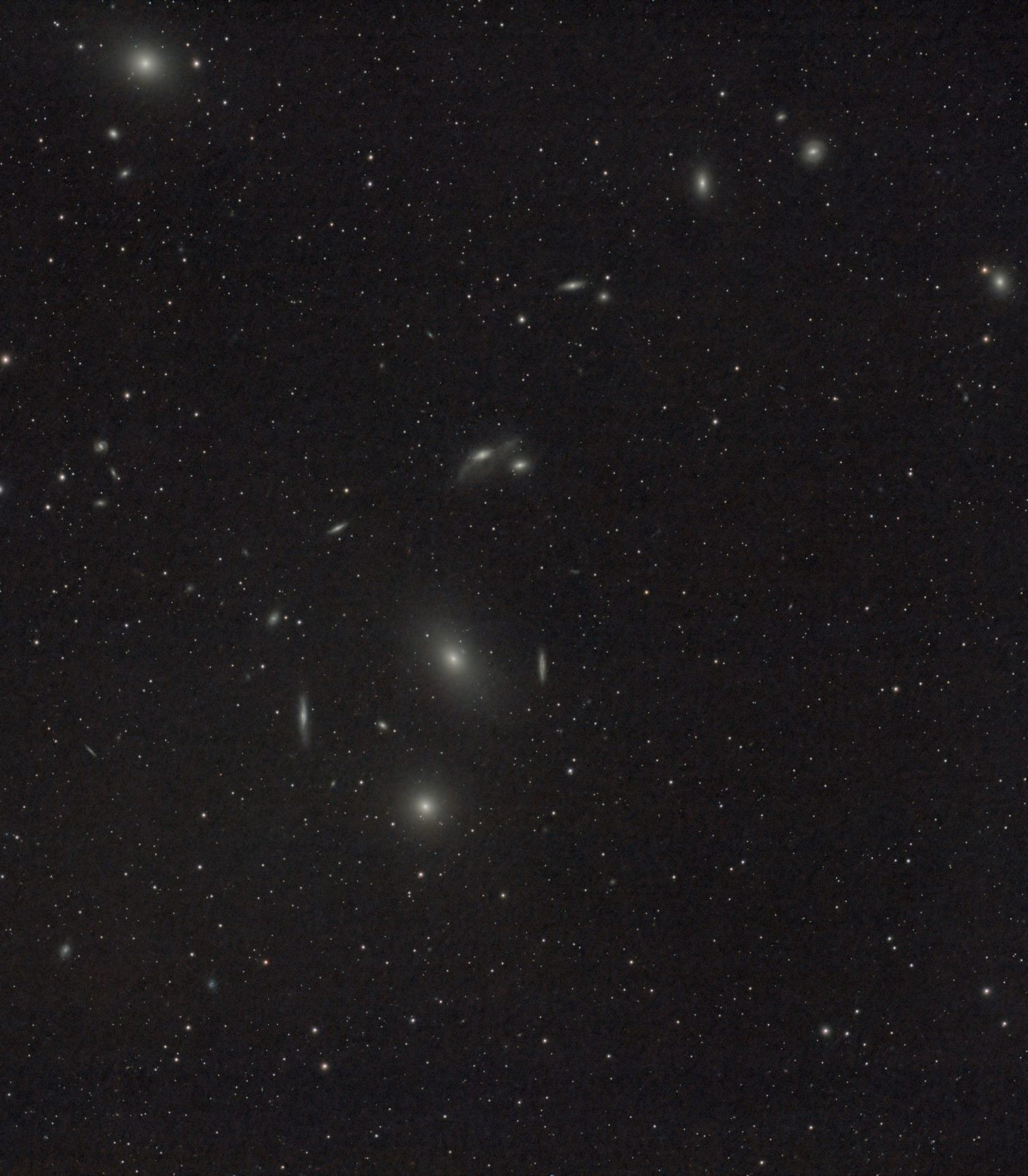
Markarian's Chain — Virgo Cluster
A sweep through the Virgo Cluster anchored by Markarian's Chain, including the giant ellipticals M84 and M86 and the interacting pair known as The Eyes (NGC 4435 / NGC 4438). The field is packed with small background galaxies, a reminder that this region is one of the nearest rich galaxy clusters beyond the Local Group.
PixInsight dark-calibrated BXT/NXT right-side crop, 2026
Technical details
- Imaging date & location
- 2014/03 · Keemale Estate, Coorg, Karnataka, India
- Processing date
- 2026/06
- Light frames
- 19 × 240 s captured at ISO 1600; 17 registered in the accepted dark-calibrated integration (~68 min)
- Calibration
- 9 darks (240 s, ISO 1600); no flats, no bias. Same-trip flats were tested and rejected for gradient artifacts.
- Mount
- Sky-Watcher NEQ6 Pro
- Imaging telescope
- Explore Scientific ED80 air-spaced doublet refractor
- Imager
- Canon EOS 60D DSLR (unmodified)
- Guide telescope
- Orion Short Tube 80
- Guide camera
- Orion StarShoot AutoGuider (SSAG)
- Capture software
-
PHD2 for guiding,
BackyardEOS for capture,
and EQMOD for mount control.
- Processing
-
PixInsight WBPP dark-calibrated/no-flats branch, conservative ABE, plate solving, SPCC, SCNR, BXT/NXT, MaskedStretch, and a right-side crop focused on the main chain.
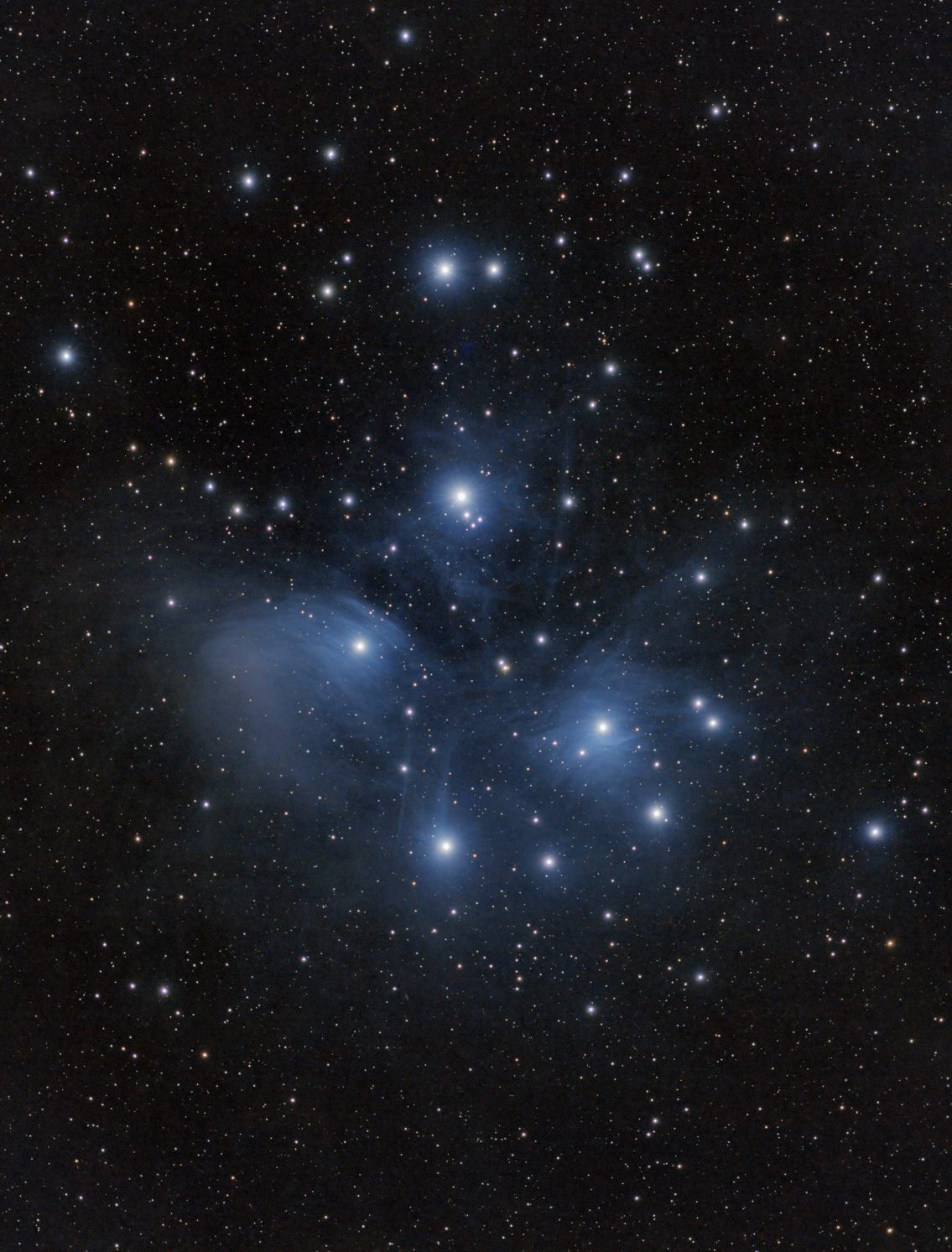
Pleiades — M45
Known as Krittika (कृत्तिका) in Indian tradition, the Pleiades is an open cluster of hot young blue stars in Taurus, wrapped in faint reflection nebulosity from the dust the cluster is currently drifting through.
PixInsight BXT/NXT portrait crop, 2026
Technical details
- Imaging date & location
- 2013/12 · Keemale Estate, Coorg, Karnataka, India
- Processing date
- 2026/05
- Light frames
- 12 × 240 s at ISO 1600 (~48 min total integration)
- Calibration
- 9 darks; no flats, no bias
- Mount
- Sky-Watcher NEQ6 Pro
- Imaging telescope
- Explore Scientific ED80 air-spaced doublet refractor
- Imager
- Canon EOS 60D DSLR (unmodified)
- Guide telescope
- Orion Short Tube 80
- Guide camera
- Orion StarShoot AutoGuider (SSAG)
- Capture software
-
PHD2 for guiding,
BackyardEOS for capture,
and EQMOD for mount control.
- Processing
-
PixInsight WBPP with matched darks, ABE, plate solving, SPCC, conservative BXT/NXT, MaskedStretch, M45-specific color/detail polish, and a portrait crop.
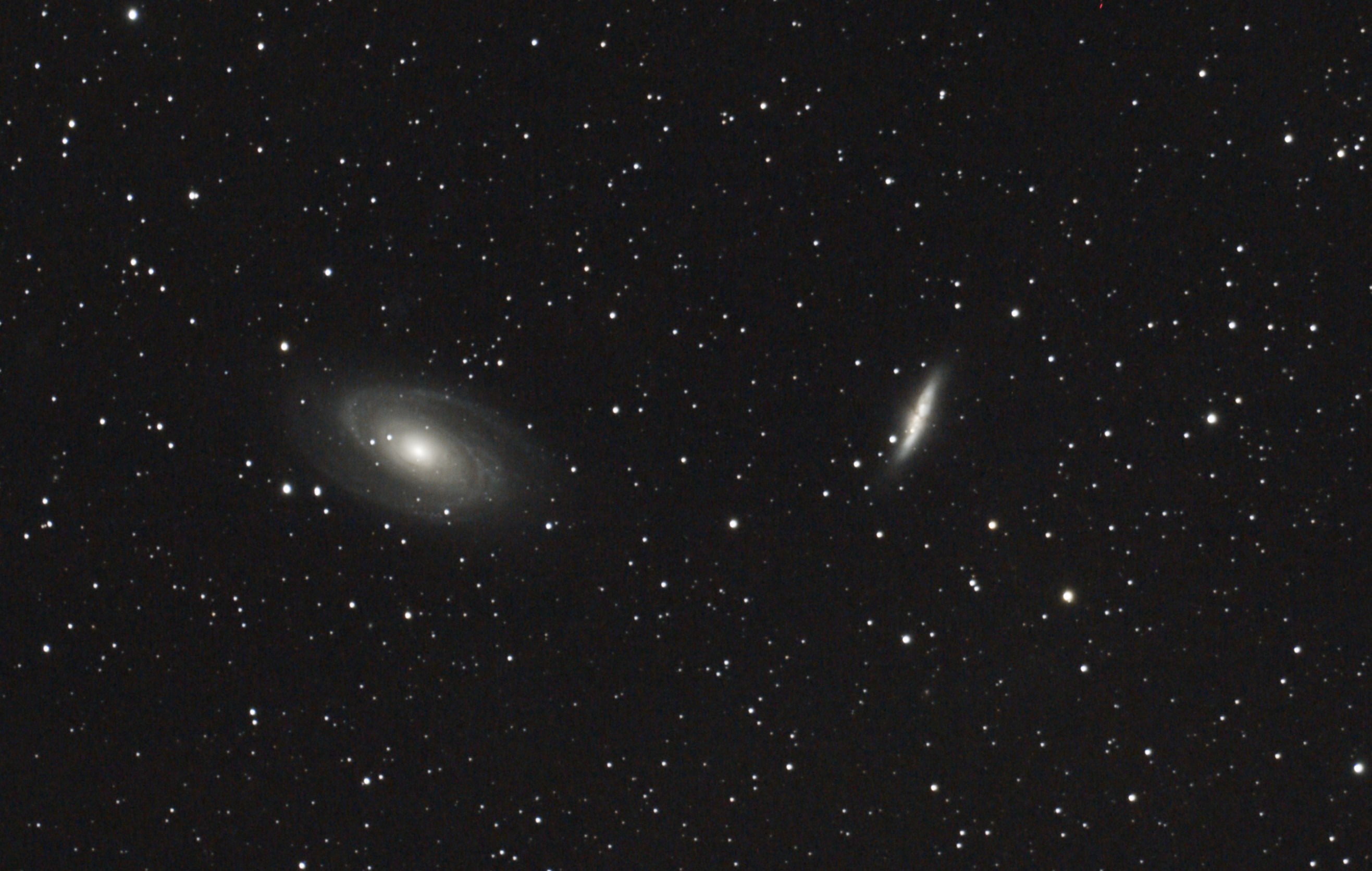
Bode's and Cigar Galaxies — M81 / M82
Two galaxies in Ursa Major caught in the same frame: M81 (Bode's Galaxy, NGC 3031), a textbook grand-design spiral, and M82 (Cigar Galaxy, NGC 3034), an edge-on irregular starburst whose core was stirred up by a close gravitational pass with M81 some hundreds of millions of years ago. Both lie about 12 million light-years away. Also visible in M82 here is SN 2014J — a Type Ia supernova discovered on 21 January 2014 by Steve Fossey at the University of London Observatory; this image was taken about six weeks after peak brightness, with the supernova still around magnitude 11.
PixInsight final v1 SN-preserving cool-dark branch, 2026
Technical details
- Imaging date & location
- 2014/03 · Keemale Estate, Coorg, Karnataka, India
- Processing date
- 2026/06
- Light frames
- 33 × 180 s selected at ISO 1600; 31 integrated after WBPP rejection (~93 min total integration)
- Calibration
- Canon EOS 60D library-01 darks (180 s, ISO 1600, +28 to +33 °C); no flats
- Mount
- Sky-Watcher NEQ6 Pro
- Imaging telescope
- Explore Scientific ED80 air-spaced doublet refractor, plate solved near 386 mm
- Imager
- Canon EOS 60D DSLR (unmodified)
- Guide telescope
- Orion Short Tube 80
- Guide camera
- Orion StarShoot AutoGuider (SSAG)
- Capture software
-
PHD2 for guiding,
BackyardEOS for capture,
and EQMOD for mount control.
- Processing
-
PixInsight cool-light/cool-dark WBPP branch, ABE, plate solving, SPCC, SCNR, stock linear noise reduction,
and an SN-preserving nonlinear v2 branch without BXT/NXT or HDR/LHE. Final v1 uses a 20% tighter presentation crop from the accepted branch.
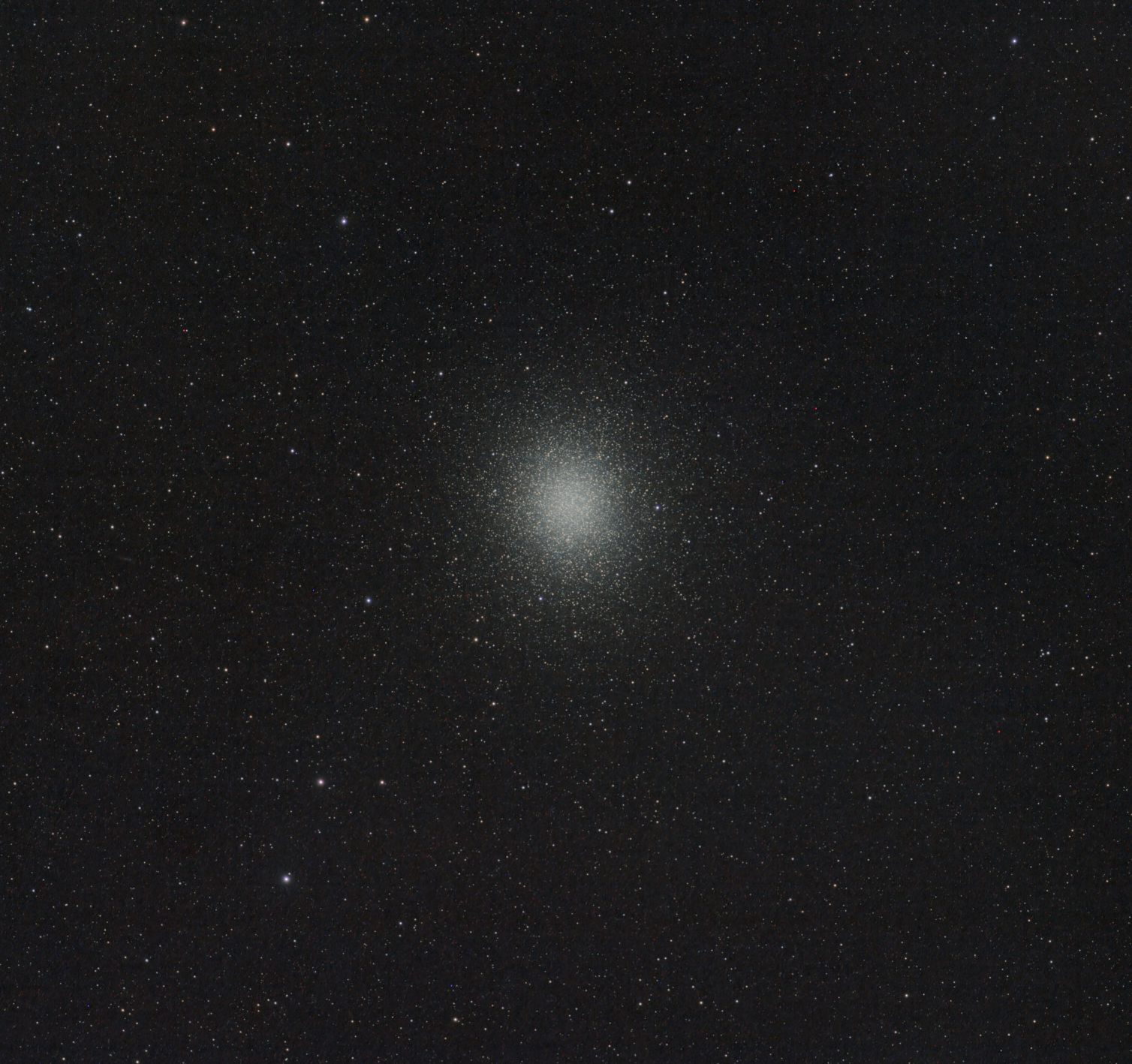
Omega Centauri — NGC 5139
The largest and most massive globular cluster orbiting the Milky Way — about 10 million stars packed into a sphere ~150 light-years across, some 17,000 light-years away. Its complex stellar populations have led many astronomers to suspect it is the stripped core of a dwarf galaxy that the Milky Way absorbed long ago. From southern India it sits low on the southern horizon, but high enough to image cleanly.
PixInsight BXT/NXT centered crop, 2026
Technical details
- Imaging date & location
- 2014/05 · Kairos resort, Yelagiri, Tamil Nadu, India
- Processing date
- 2026/06
- Light frames
- 27 × 60 s at ISO 800 (~27 min total integration)
- Calibration
- None (no darks, flats, or bias)
- Mount
- Sky-Watcher NEQ6 Pro
- Imaging telescope
- Explore Scientific ED80 air-spaced doublet refractor
- Imager
- Canon EOS 60D DSLR (unmodified)
- Guide telescope
- Orion Short Tube 80
- Guide camera
- Orion StarShoot AutoGuider (SSAG)
- Capture software
-
PHD2 for guiding,
BackyardEOS for capture,
and EQMOD for mount control.
- Processing
-
PixInsight WBPP no-dark/no-flats branch, ABE, plate solving, SPCC, SCNR, conservative BXT/NXT for the dense star field, MaskedStretch, and a centered presentation crop.
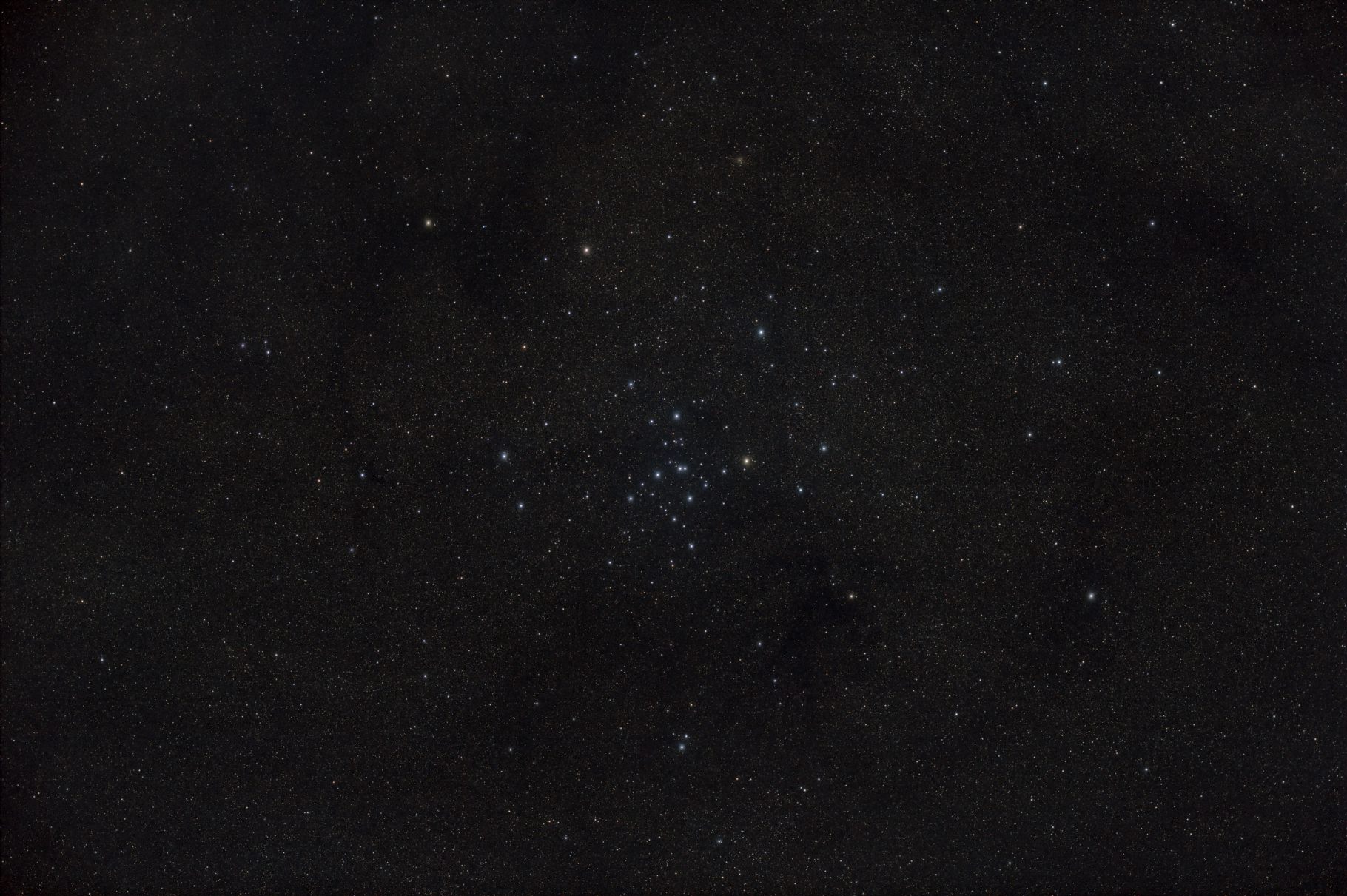
Ptolemy Cluster — M7 / NGC 6475
A bright open cluster in Scorpius, also known as the Ptolemy Cluster. M7 is the southernmost Messier object, a broad Milky Way star field of blue-white and warmer stars about 980 light-years away.
PixInsight BXT/NXT MaskedStretch accepted branch, 2026
Technical details
- Imaging date & location
- 2013/03 · Yelagiri YMCA camp, Tamil Nadu, India
- Processing date
- 2026/06
- Light frames
- 5 × 120 s at ISO 1600 (~10 min total integration)
- Calibration
- No darks, flats, or bias in the accepted 120 s branch; warmer dark libraries were kept as diagnostics only
- Mount
- Sky-Watcher NEQ6 Pro
- Imaging telescope
- Explore Scientific ED80 air-spaced doublet refractor, plate solved at 480.31 mm
- Imager
- Canon EOS 60D DSLR (unmodified)
- Guide telescope
- Orion Short Tube 80
- Guide camera
- Orion StarShoot AutoGuider (SSAG)
- Capture software
-
PHD2 for guiding,
BackyardEOS for capture,
and EQMOD for mount control.
- Field of view
- ~2° 40′ × 1° 47′ after autocrop; 1.851 arcsec/px
- Processing
-
PixInsight 120 s no-dark/no-flats WBPP branch, ABE, plate solving, SPCC, SCNR, stock linear noise reduction,
conservative BXT/NXT, and a regular MaskedStretch with target background 0.075. A darker local-contrast sibling was tested but not promoted.
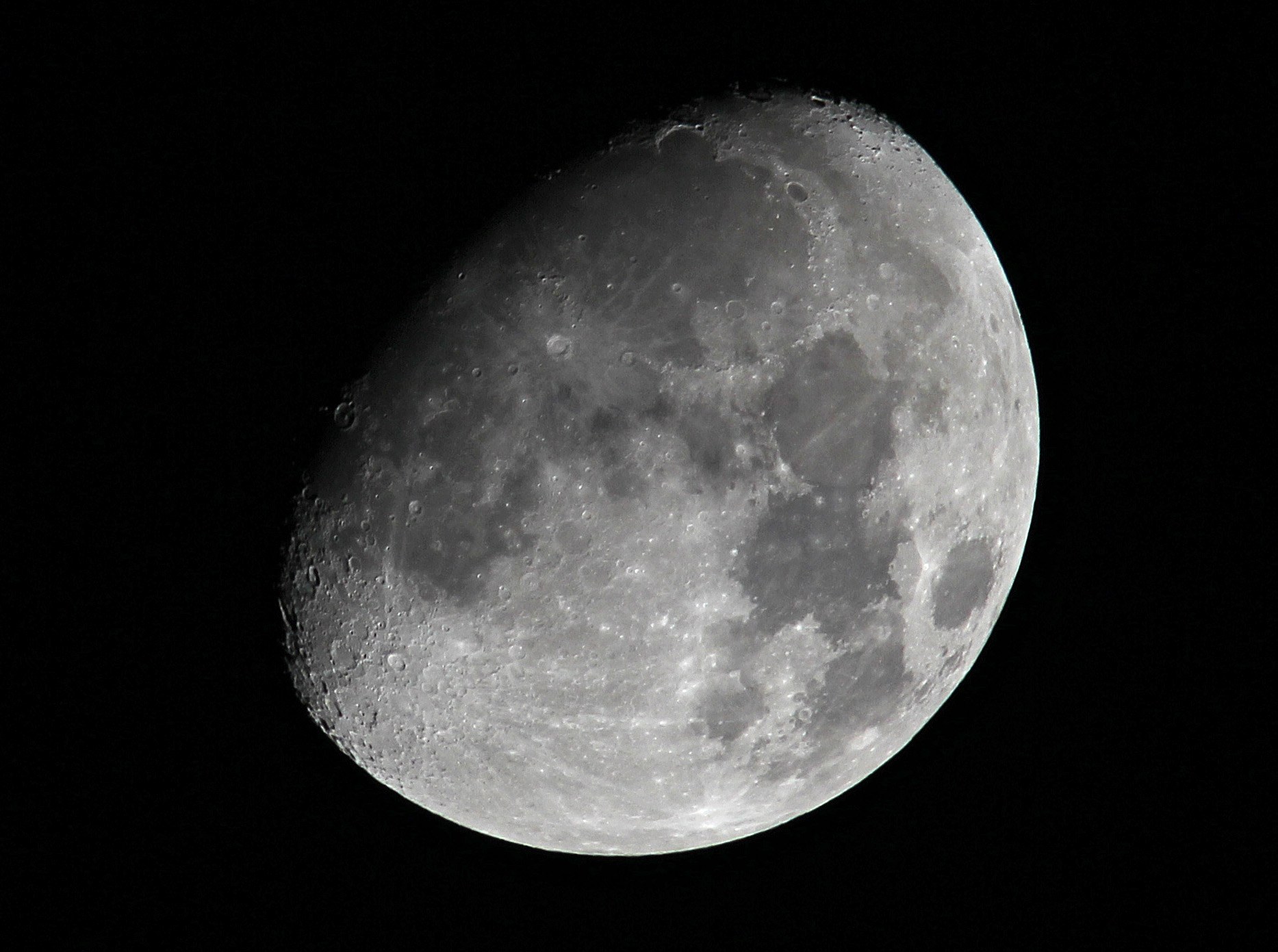
Gibbous Moon — 31 May 2012
One of the earliest astrophotography attempts in this collection — a Bangalore back-terrace shot of the waxing gibbous Moon, taken at the long end of a borrowed telephoto lens. Within days I'd shoot the Venus transit on the same kit; within a year the Sky-Watcher NEQ6 + ED80 setup arrived and the deep-sky work began.
Technical details
- Date & location
- 31 May 2012, 23:33 IST · Bangalore, India
- Camera
- Canon EOS 60D
- Lens
- Canon EF 400 mm f/5.6L USM with Canon 1.4× extender — effective 560 mm at f/8 (borrowed from Toehold)
- Mount
- Photo tripod (untracked)
- Exposure
- 1/125 s at ISO 100 (single frame)
- Software
- BackyardEOS for focus, Adobe Photoshop Elements 8 for sharpening.
- Note
- Lesson learned: there is NO substitute for a good long lens. The lens and TC are borrowed; it's so heavy I have to now look for a sturdier tripod. Struggled to keep up with the racing Moon in a 1.5° vertical field of view. (original caption, May 2012)
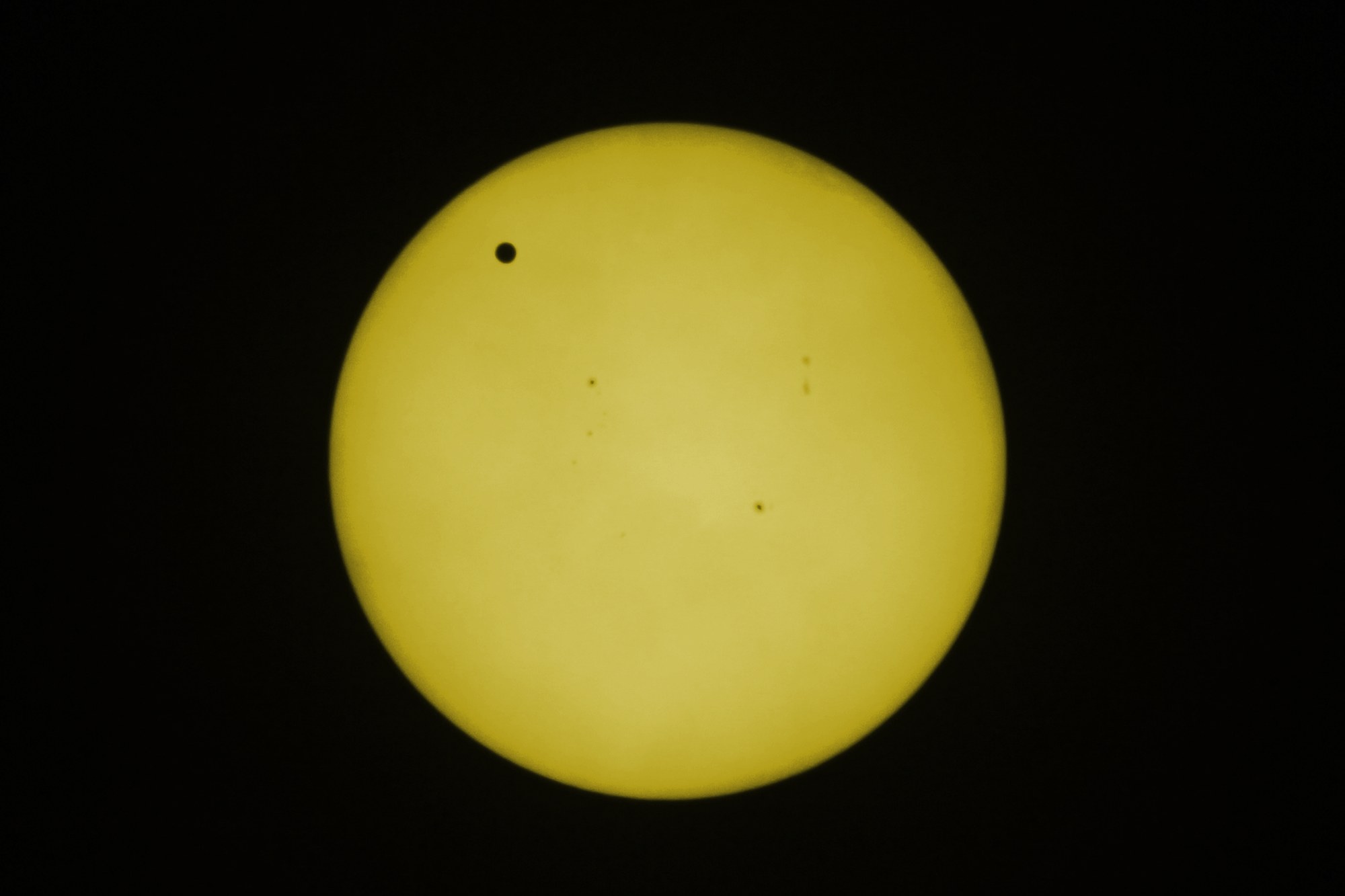
Venus Transit — 6 June 2012
Venus crossing the disc of the Sun, captured from Bangalore on 6 June 2012. Transits of Venus come in pairs separated by ~8 years, with each pair separated by ~105 or ~121 years — this was the second of the 2004/2012 pair. The next one is in December 2117.
Technical details
- Date & location
- 6 June 2012 · Bangalore, India (capture window ~08:34–10:24 IST)
- Camera
- Canon EOS 60D
- Lens
- Canon EF 400 mm f/5.6L USM with Canon 1.4× extender — effective focal length 560 mm at f/8
- Mount
- Manfrotto photo tripod (untracked)
- Solar filter
- Baader AstroSolar safety film (visual / ND 5)
- Exposure
- Varied through the morning (e.g. 1/2000 s @ ISO 100, 1/100 s @ ISO 400)
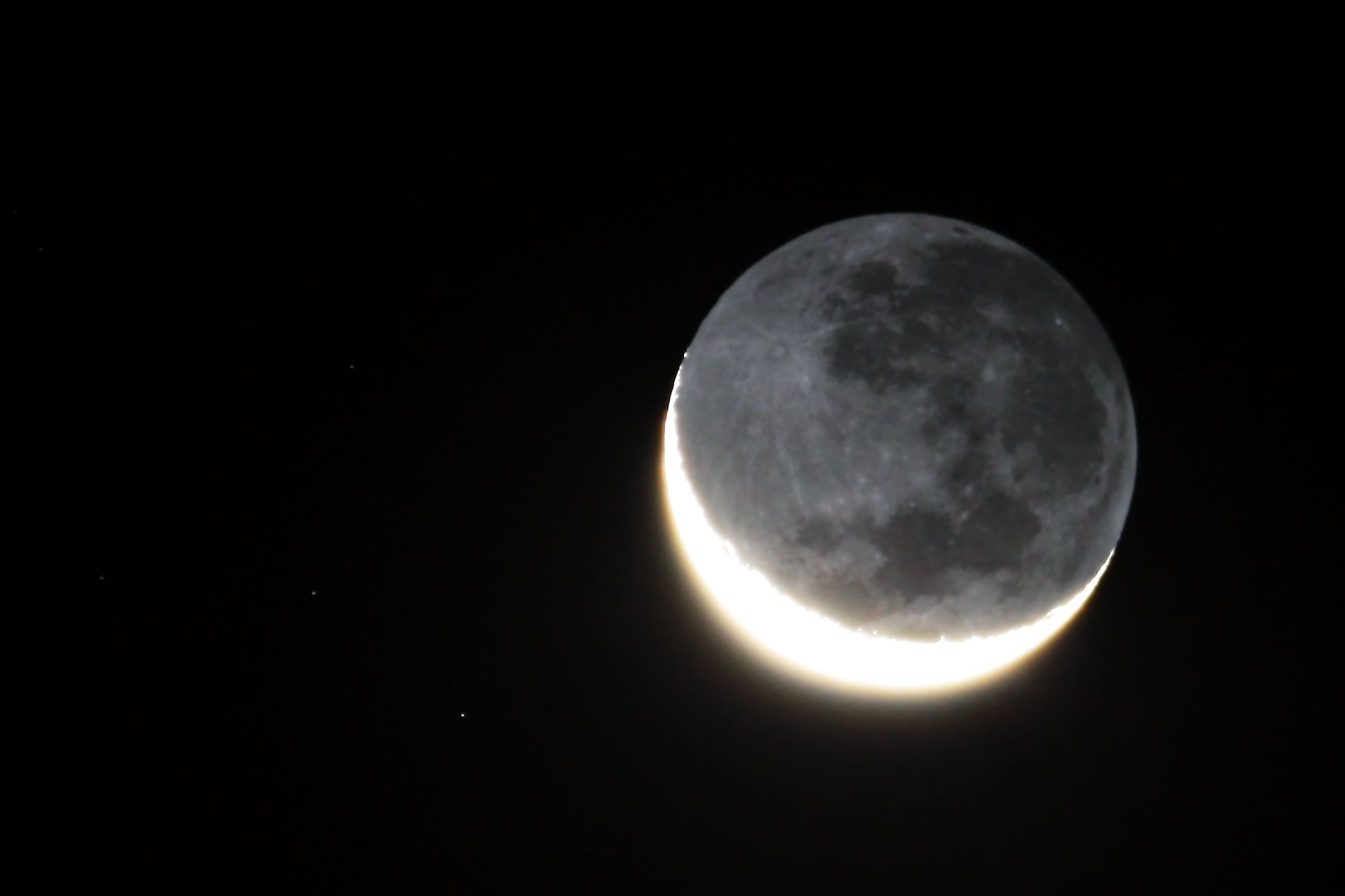
Earthshine on a Crescent Moon — 2 February 2014
The thin waxing crescent with the dark portion of the lunar disc faintly illuminated by earthshine — sunlight bouncing off Earth's clouds, oceans, and ice and back onto the Moon's night side. Leonardo da Vinci was the first to explain this glow correctly, around 1510. A 2-second exposure is just long enough to bring out the earthshine while keeping the bright sunlit crescent recognisable.
Technical details
- Date & location
- 2 February 2014, 19:08 IST · Bangalore, India
- Camera
- Canon EOS 60D
- Imaging telescope
- Explore Scientific ED80 air-spaced doublet refractor
- Mount
- Sky-Watcher NEQ6 Pro
- Exposure
- 2 s at ISO 800 (single frame; sensor temperature +42 °C)
- Software
- Canon Digital Photo Professional for raw conversion, Adobe Photoshop for tone and crop.
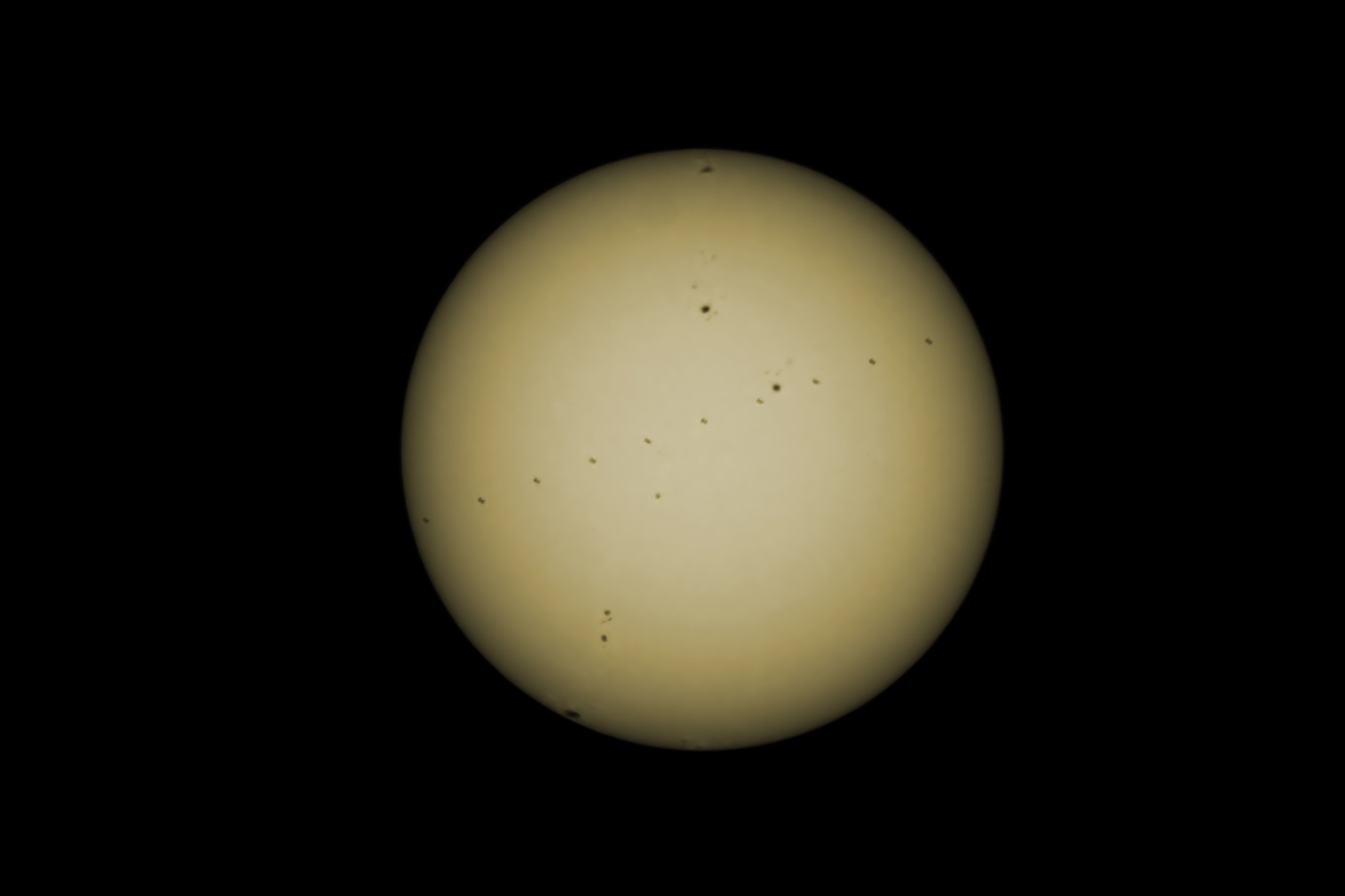
ISS Solar Transit — 9 February 2014
The International Space Station silhouetted against the Sun's disc, captured from Bangalore. The ISS orbits Earth at about 7.66 km/s, so a transit across the Sun's apparent diameter lasts roughly half a second — the image is a composite of ten frames shot in a single one-second burst at 1/640s. Predicted in advance with CalSky; framed and timed so the camera was already firing when the station appeared.
Technical details
- Date & location
- 9 February 2014, 16:55:56 IST · Bangalore, India
- Camera
- Canon EOS 60D
- Lens
- Canon EF 100-400 mm f/4.5-5.6L IS USM with Canon 1.4× extender — used at 400 mm × 1.4 = 560 mm at f/8
- Mount
- Manfrotto photo tripod (untracked)
- Solar filter
- Baader AstroSolar safety film (visual / ND 5)
- Exposure
- 1/640 s at ISO 100; 10-frame burst in approximately one second
- Software
- Adobe Photoshop CS6 for compositing the burst frames into the final image.
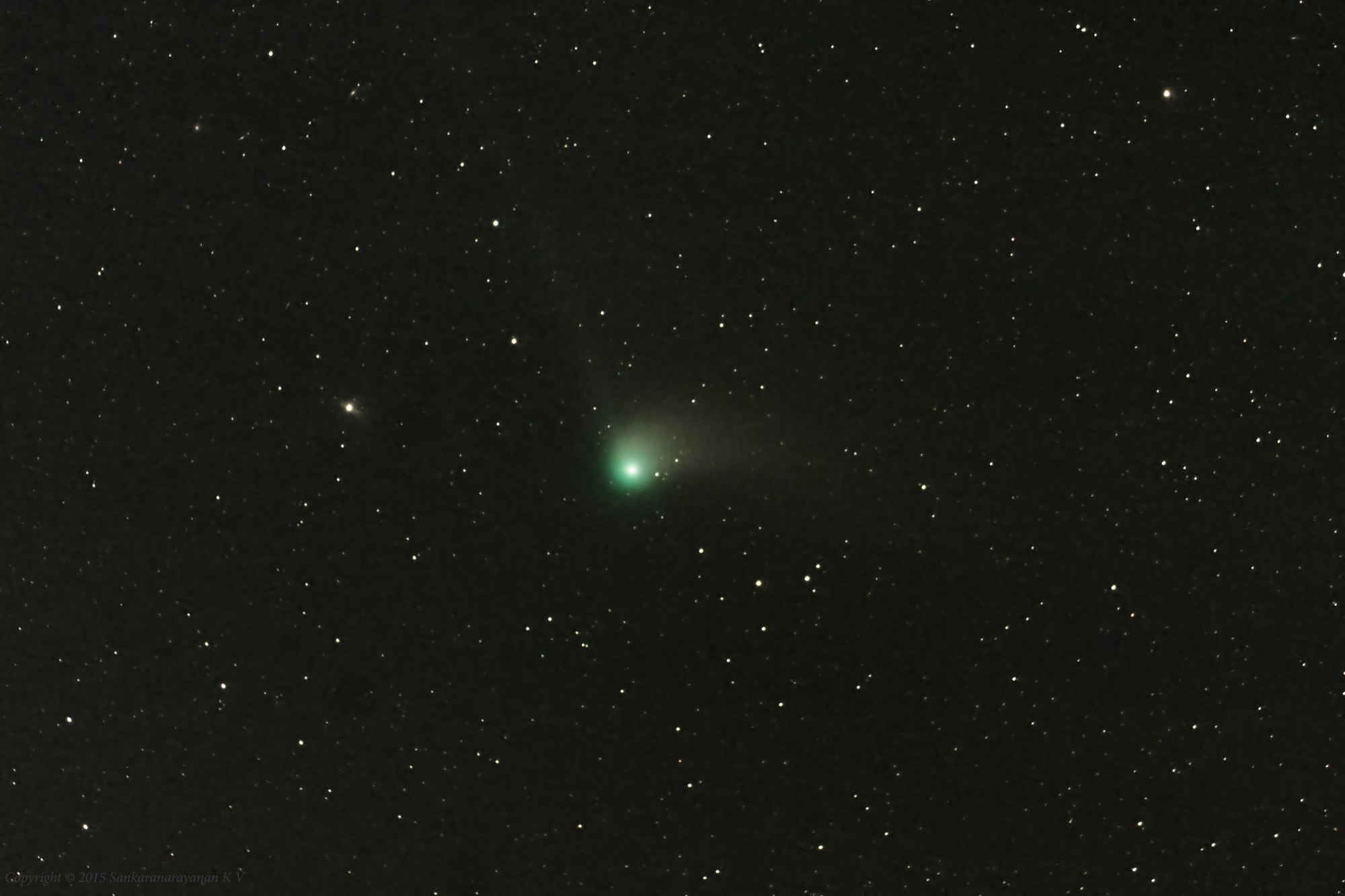
Comet Catalina — C/2013 US10
Comet C/2013 US10 (Catalina) — a hyperbolic comet from the Oort cloud, discovered by the Catalina Sky Survey in October 2013. It made its closest approach to Earth on 17 January 2016 at about 0.72 AU, and afterwards left the solar system on a one-way trajectory. This frame was shot a week before that closest approach, in the pre-dawn sky from Yelagiri.
Technical details
- Date & location
- 8 January 2016 · Yelagiri YMCA camp, Tamil Nadu, India (capture window 04:30–04:54 IST)
- Light frames
- 5 × 120 s at ISO 1600 (~10 min total integration; 12 captured, best 5 stacked)
- Calibration
- None (no darks, flats, or bias)
- Mount
- Sky-Watcher NEQ6 Pro
- Imaging telescope
- Explore Scientific ED80 air-spaced doublet refractor
- Imager
- Canon EOS 60D DSLR (unmodified)
- Guide telescope
- Orion Short Tube 80
- Guide camera
- Orion StarShoot AutoGuider (SSAG)
- Software
-
PHD2 for guiding,
BackyardEOS for capture,
EQMOD for mount control,
DeepSkyStacker star-aligned stacking (Kappa-Sigma, κ=2, 5 iterations; per-channel background calibration),
and Adobe Photoshop CC 2015 for processing.
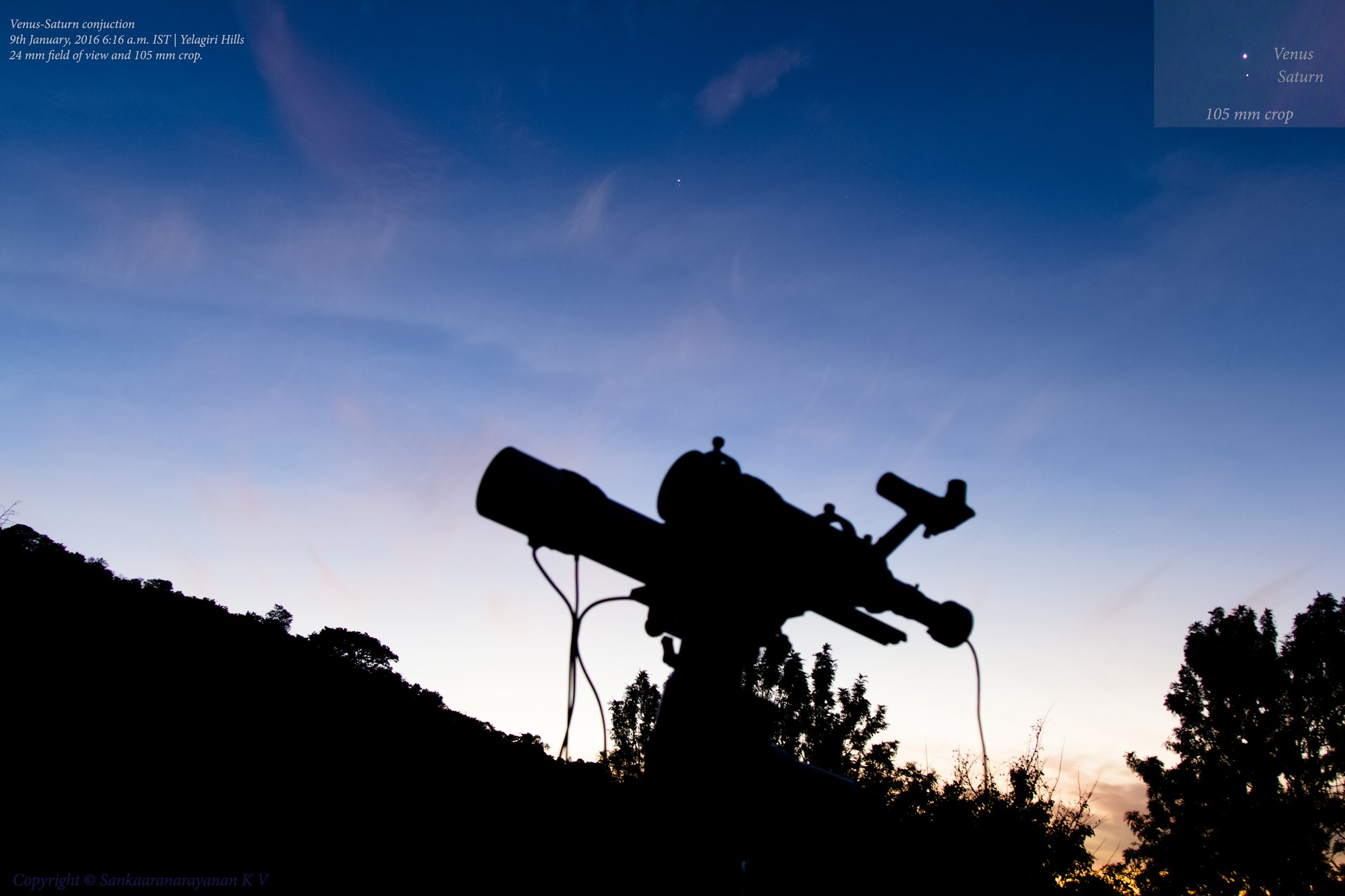
Venus–Saturn Conjunction — 9 January 2016
Venus and Saturn at their closest apparent separation in this conjunction, with the bright Venus easily outshining Saturn just below it. A wide-angle dawn frame from Yelagiri showing the two planets above the eastern horizon.
Technical details
- Date & location
- 9 January 2016, 06:16 IST · Yelagiri YMCA camp, Tamil Nadu, India
- Camera
- Canon EOS 60D
- Lens
- Canon EF 24-105 mm f/4L IS USM at 24 mm, f/4
- Exposure
- 1/6 s at ISO 400 (single frame)
- Software
- Adobe Photoshop CC 2015 for processing.
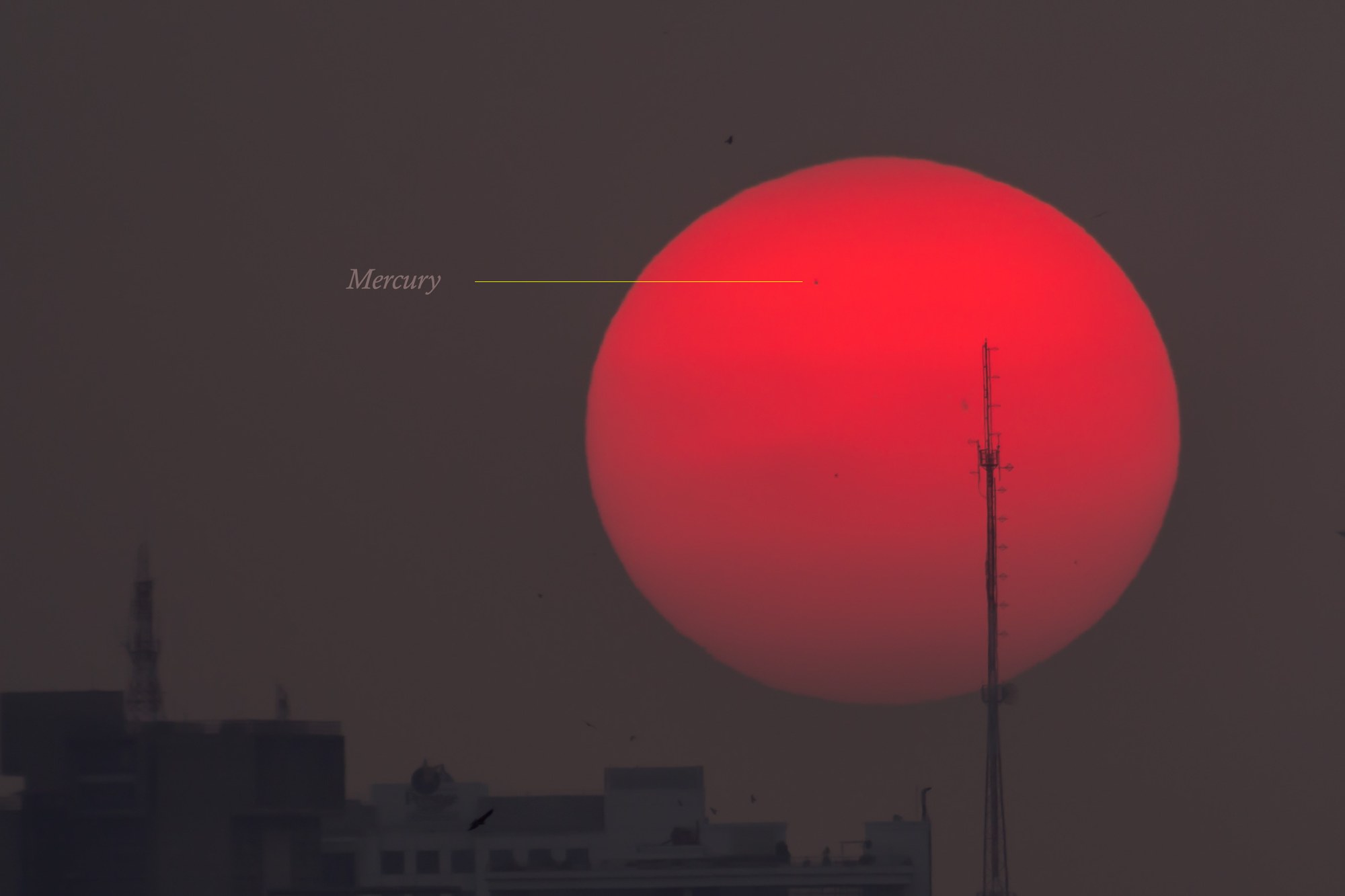
Mercury Transit — 9 May 2016
Mercury silhouetted as a tiny dark dot against the Sun's disc — the planet is only about 0.005% of the Sun's apparent area. Mercury transits happen 13 or 14 times per century in May or November; this one was visible from India only partially, between transit start at ~16:42 IST and local sunset around 18:50 IST. Captured over a 2.5-hour window from Bangalore.
Technical details
- Date & location
- 9 May 2016, capture window 16:08–18:32 IST · Bangalore, India
- Camera
- Canon EOS 60D
- Imaging telescope
- Explore Scientific ED80 air-spaced doublet refractor (480 mm at f/6)
- Mount
- Sky-Watcher NEQ6 Pro (solar tracking)
- Solar filter
- Baader AstroSolar safety film (visual / ND 5)
- Exposure
- 1/1600 s at ISO 100 (single frame from a 289-shot session)
- Software
- Adobe Photoshop CC 2015 for cropping and processing.
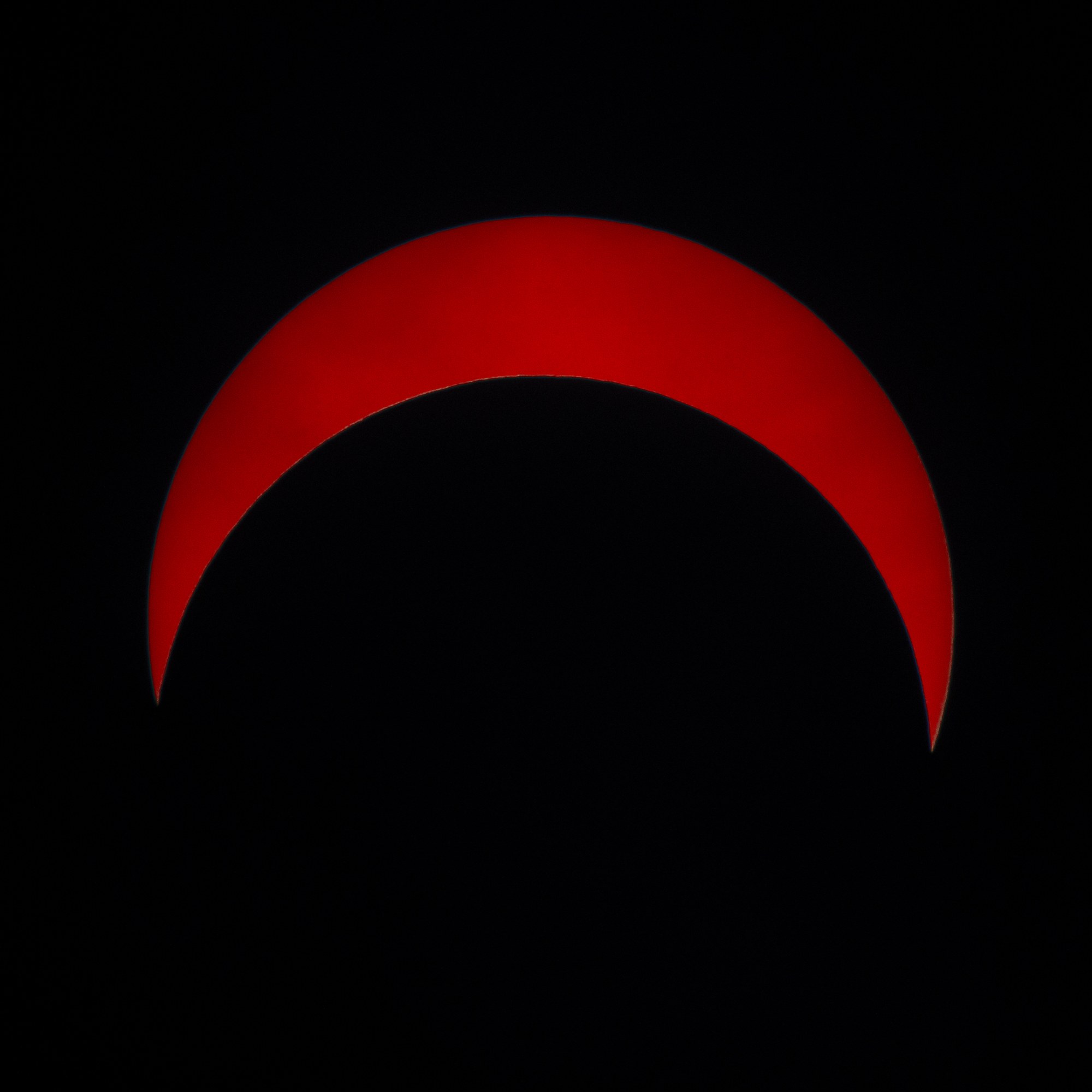
Solar Annular Eclipse — 26 December 2019
The annular ("ring of fire") solar eclipse of 26 December 2019. The path of annularity passed across South India through Kerala, Tamil Nadu, and Karnataka; from Bangalore the Sun was about 89% covered at maximum at 09:25 IST, producing this deep crescent. The next solar eclipse visible from Bangalore is in March 2034.
Technical details
- Date & location
- 26 December 2019 · Bangalore, India (capture window 08:15–11:31 IST; eclipse maximum at 09:25 IST)
- Camera
- Canon EOS 60D
- Lens
- Canon EF 100-400 mm f/4.5-5.6L IS II USM with Canon 2× extender — used at 400 mm × 2 = 800 mm at f/11
- Mount
- Manfrotto photo tripod (untracked)
- Solar filter
- Baader AstroSolar safety film (visual / ND 5)
- Exposure
- Single frame at 1/160 s, ISO 1600 (from a 37-shot session)
- Software
- Adobe Photoshop Camera Raw 12 / Photoshop CC for processing.
Among Stars — Yelagiri terrace, Jan 2013
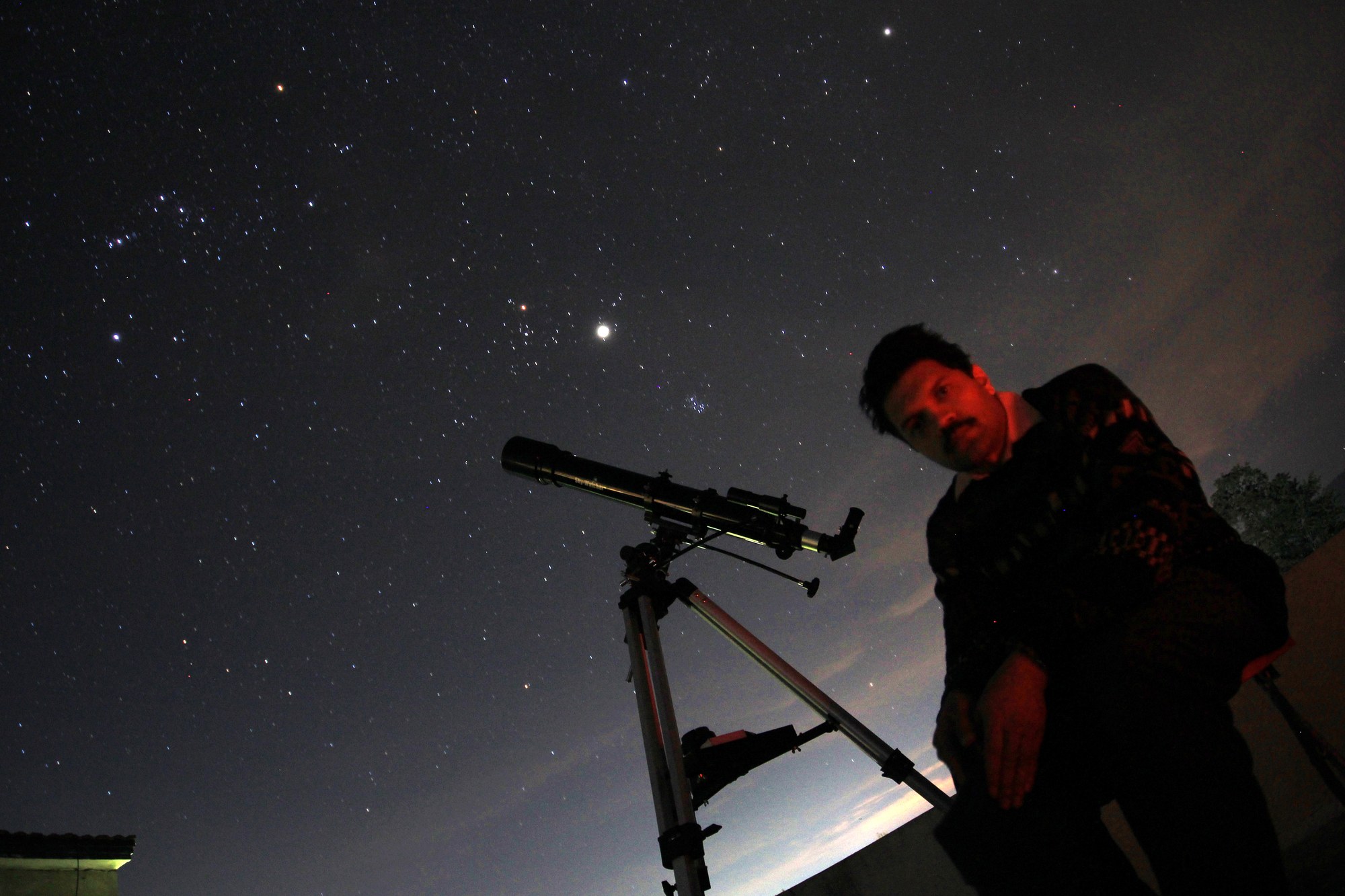
A self-portrait under the western sky from the Yelagiri YMCA camp terrace, with Orion, Taurus, Jupiter, and the Pleiades arrayed overhead. The face is lit by laptop screen glow; the diffuse glow on the western horizon is light pollution made visible by the long exposure. Originally posted to Flickr as "Among stars".
Technical details
- Date & location
- 14 January 2013, 00:07 IST · Yelagiri YMCA camp, Tamil Nadu, India
- Camera
- Canon EOS 60D on a Manfrotto tripod
- Lens
- Sigma 10-20 mm f/4-5.6 EX DC HSM at 11 mm, f/4.5
- Exposure
- 45 s at ISO 800 (single frame)
- Software
- Adobe Photoshop Express for processing.
At the eyepiece
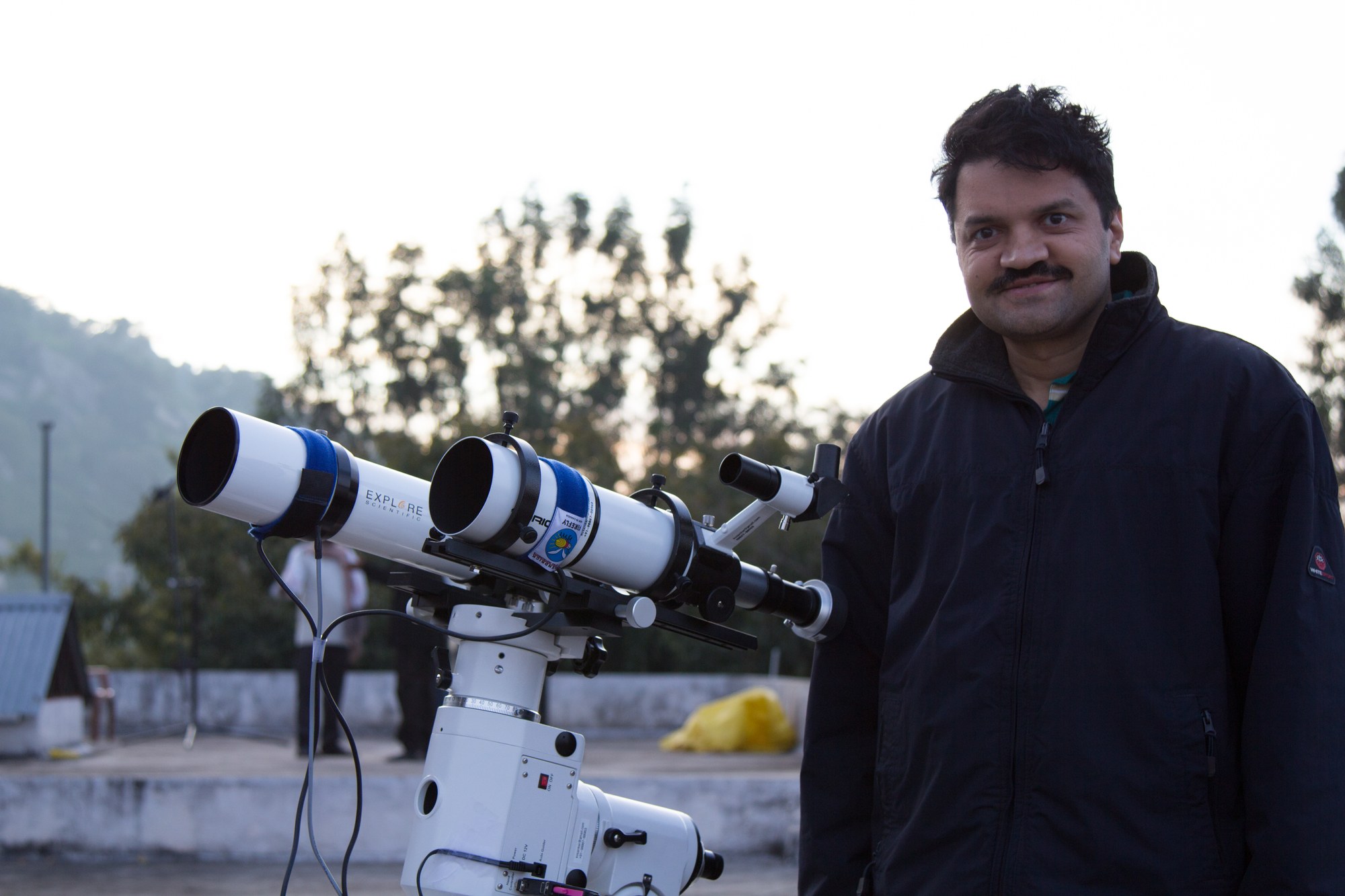
With the gear that did most of the work in this gallery — the Sky-Watcher NEQ6 Pro mount, the Explore Scientific ED80 imaging refractor, the Orion Short Tube 80 piggybacked for guiding, and the Canon EOS 60D at the focuser. A self-portrait, c. 2013–2014.